The Ask Amount Might Be the Most Underrated Lever in Your Fundraising Strategy
Mar 2026 - READ IN 7 MINUTES


Advancement teams obsess over subject lines, segmentation, design, timing, channels, you name it.
But there’s one variable quietly shaping donor behavior, retention, and long-term revenue that often gets set once… and left alone: The ask amount.
Our new Smart Ask Amounts White Paper digs into millions of gifts to answer a deceptively simple question:
What happens after a donor upgrades, retains, or downgrades their gift—and how much does the original ask influence that trajectory?
The findings may change how you think about your giving forms, email appeals, and campaign strategy.
The Real Pain Point: Guesswork Disguised as Strategy
Let’s be honest about how most ask arrays are built.
- “We’ve always used $100, $250, $500…”
- “That’s what peer schools are doing.”
- “It performed fine last year.”
- “Development felt good about it.”
There’s institutional wisdom in those decisions. But there’s also a lot of intuition filling in the gaps.
Meanwhile, donor expectations are rising, personalization is table stakes, and advancement leaders are being asked to do more with leaner teams. The fact is:
- Manual ask strategies don’t scale.
- Static arrays don’t adapt.
- And broad segmentation only gets you so far.
So the question becomes: What if the right ask amount isn’t a committee decision—but a data decision?
What the White Paper Explores
The Smart Ask Amounts White Paper analyzes longitudinal giving data to understand how short-term donor behavior predicts long-term outcomes.
Specifically, it examines what happens when donors:
- Upgrade
- Retain
- Downgrade
The differences over time are substantial.
Looking across multiple years of historical giving, donors who retain their support consistently outperform those who downgrade, while donors who upgrade generate dramatically higher long-term value. In other words, modest differences at the point of ask can translate into meaningfully different giving trajectories over time. In fact, our models show that donors who upgrade today will give twice as much as downgraders over the next three years.
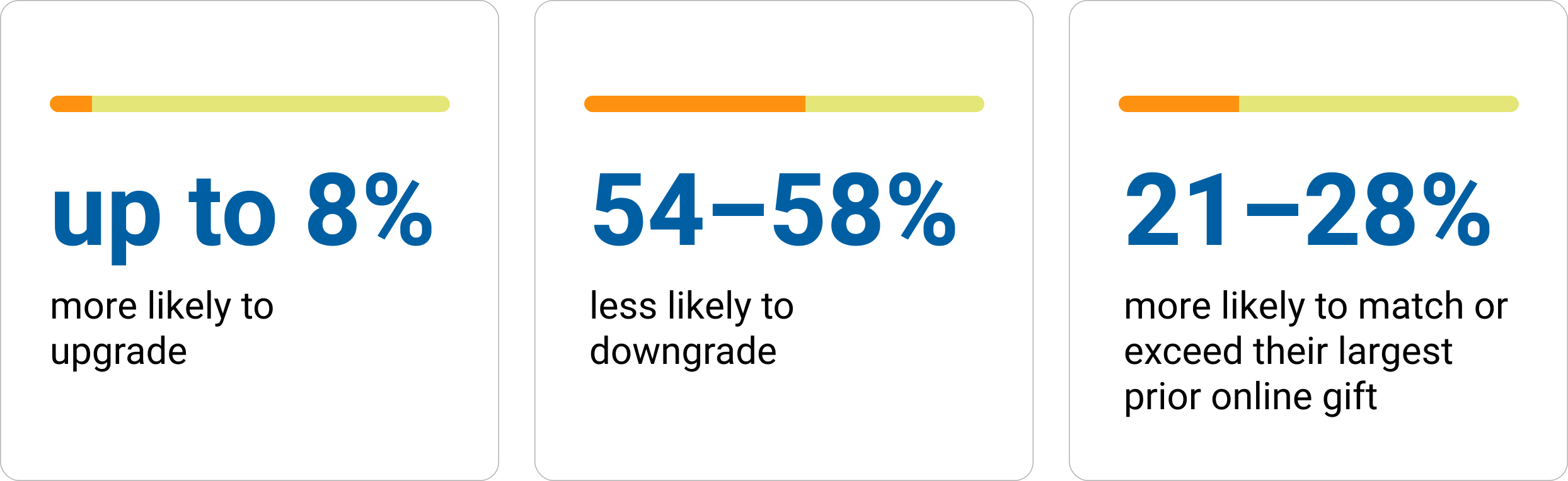
The key takeaway is clear: Short-term donor behavior is a powerful signal of long-term engagement.
And what influences that short-term behavior? In part, the amount you ask.
4 Common Questions Advancement Teams Pose About AI-Recommended Ask Amounts
If you’re exploring AI-powered ask strategies, you’re probably asking some version of these questions:
1. Isn’t this just fancy automation?
No. Modern predictive modeling analyzes historical giving behavior, capacity signals, engagement data, and other inputs to recommend an ask amount tailored to the individual donor—not just their segment.
This goes beyond static tiers. It’s dynamic and donor-specific.
At GiveCampus, Smart Ask Amounts are powered by GC Intelligence, AI that’s designed specifically for educational fundraising. The goal is more than just automation, it’s smarter decision-making at scale.
2. Will this alienate donors if the amount feels too high?
This is one of the most common concerns of advancement teams.
The research suggests the opposite risk may be more costly (i.e., setting your ask too low).
When donors are consistently under-asked, institutions leave upgrade opportunities on the table. And upgrades are strongly correlated with stronger long-term trajectories.
Predictive ask strategies are designed to balance likelihood and capacity—helping you avoid both overreaching and undershooting.
3. We already segment our appeals. Isn’t that enough?
Segmentation is valuable. But within any segment, donor behavior varies widely.
Two alumni in the same class year with similar past gifts may have very different future potential. AI-recommended ask amounts operate at the individual level, something manual segmentation simply can’t replicate at scale.
4. How does this actually work in practice?
Smart Ask Amounts integrate directly into your giving experience, so the right donor sees the right suggested amount at the right time.
And because ask strategy doesn’t live in a vacuum, it works hand-in-hand with outreach tools like GC Outreach, allowing you to pair personalized asks with targeted, multichannel communication.
In other words:
- Smarter asks
- Smarter outreach
- Smarter follow-through
All without turning your advancement shop into a data science lab.
Why This Matters More Than Ever
Advancement leaders are under pressure to:
- Improve donor retention
- Grow average gift size
- Increase campaign ROI
- Demonstrate long-term sustainability
But most strategies focus on acquisition or short-term lift.
The white paper reframes the conversation. Instead of asking, “Did this campaign perform?” it asks:
- Did donors upgrade?
- Did they retain?
- Did they downgrade?
- And what does that signal for the next three years?
This is where compounding effects come into play.
Small improvements in upgrade and retention rates today don’t just impact this year’s revenue. They shape the trajectory of your donor file over time.
AI in Advancement: Hype or Strategic Advantage?
AI is everywhere in higher ed conversations right now. Some of it is noise. Some of it is transformative. The difference comes down to application.
When AI is purpose-built for educational fundraising—trained on real giving behavior and embedded into real workflows—it becomes less about buzzwords and more about outcomes.
GC Intelligence is designed to support advancement teams in practical ways:
- Recommending optimized ask amounts
- Identifying likely responders
- Generating high-quality first drafts for outreach
- Enhancing personalization at scale
A Simple but Powerful Question
What if your ask amount isn’t just influencing this gift but the next three years of giving?
That’s the question at the heart of the Smart Ask Amounts White Paper.
If you’re thinking about:
- Modernizing your giving forms
- Improving donor retention
- Increasing average gift size
- Leveraging AI responsibly and strategically
This research is worth your time.
Because in fundraising, what happens next often depends on what happens at the ask.
And the institutions that get smarter about that lever sooner may find the impact compounds faster than they imagined.
Ready to Put Smarter Ask Strategies Into Practice?
Whether you’re a longtime GiveCampus partner or just beginning to explore what AI-powered fundraising can do, here’s how to put that intelligence to work for your institution.
On our Giving Day, nearly half of donors who received Smart Ask Amounts gave more than they did last year. Smart Ask Amounts played a huge role in our success, and I will definitely use them again.Katherine Malchoff Westminster School
Already Using GiveCampus Online Giving?
Good news: Smart Ask Amounts and other AI-powered capabilities are already part of your GiveCampus Online Giving platform. The intelligence is there, you just have to turn it on.
Connect with your Partner Success Manager or Account Manager to review your data setup and activate Smart Ask Amounts to their fullest potential.

Your peers are already seeing stronger upgrades and higher conversion rates. Let’s make sure you are, too.
Not Yet Using GiveCampus Online Giving?
If you’re evaluating online giving solutions, here’s what makes GC Online Giving different:
- Predictive intelligence is built in, it’s not an add-on
- Personalization happens automatically at scale
- Machine learning and generative AI power key donor-facing experiences
- Everything is embedded inside a platform purpose-built for schools
GC Intelligence works because it lives inside the workflows you already use—no extra tools, no fragile integrations.
Request a demo of GC Online Giving to see Smart Ask Amounts and other GC Intelligence capabilities in action, and learn how schools are raising more dollars with less effort.