Master Class: How to Build a High-Performing Digital Gift Officer Team
Apr 2026 - READ IN 15 MINUTES
One of the most persistent (and expensive) blind spots in advancement lives right in the middle of the pipeline.
Annual giving teams are built to scale. Major gift teams are built to close. But the donors in between—the ones with real capacity, real affinity, and real potential—often sit in a kind of strategic no-man’s land.
They’re too small for major gifts, too important for mass marketing, and all too often, they go unmanaged.
That’s the gap the team at William & Mary set out to solve. What they built is a fully operational Digital Gift Officer (DGO) model, now supported by GiveCampus and its GC Gift Officer solution.
The result? More than $3.1 million raised through a structured, cadence-driven approach to donor engagement in under two years, along with something just as valuable: a healthier, more predictable pipeline.
This Master Class is based on a GCPC session presented by Meghan D. Palombo, Associate Vice President for Annual Giving & Philanthropic Engagement at William & Mary, who leads the university’s annual giving strategy across digital, leadership, reunion, and young alumni programs.
We’re grateful to Meghan for generously sharing her team’s work and insights with peers across advancement.
Let’s take a closer look at how they did it—and what it takes to build a DGO program that delivers.
About William & Mary
Founded in 1693 and located in Williamsburg, Virginia, William & Mary is one of the nation’s oldest public institutions, with a student population that is approximately 71% undergraduate and 29% graduate.
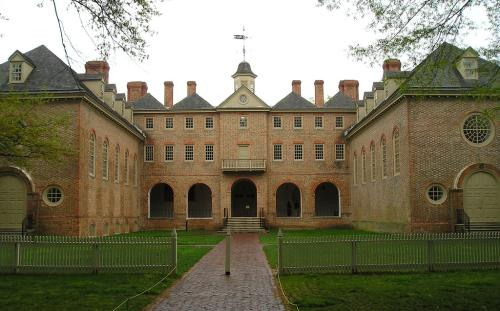
Its advancement operation is both sizable and notably integrated, with more than 250 professionals spanning annual giving, alumni engagement, development, advancement services, and areas not always housed within advancement—such as careers, university communications, and marketing that supports enrollment.
This broad, interconnected structure became especially important during William & Mary’s “For the Bold” campaign, a comprehensive effort designed to elevate the university’s impact and expand philanthropic support. As campaign priorities took shape, so did the need for a more intentional approach to donor pipeline development—particularly among donors who had demonstrated affinity and capacity but were not yet engaged at a major gift level.
The DGO program emerged as a strategic response to that need, helping ensure that more donors could be cultivated, qualified, and moved through the pipeline in a coordinated and scalable way.
The Real Opportunity: Owning the “Missing Middle” in Your Donor Pipeline
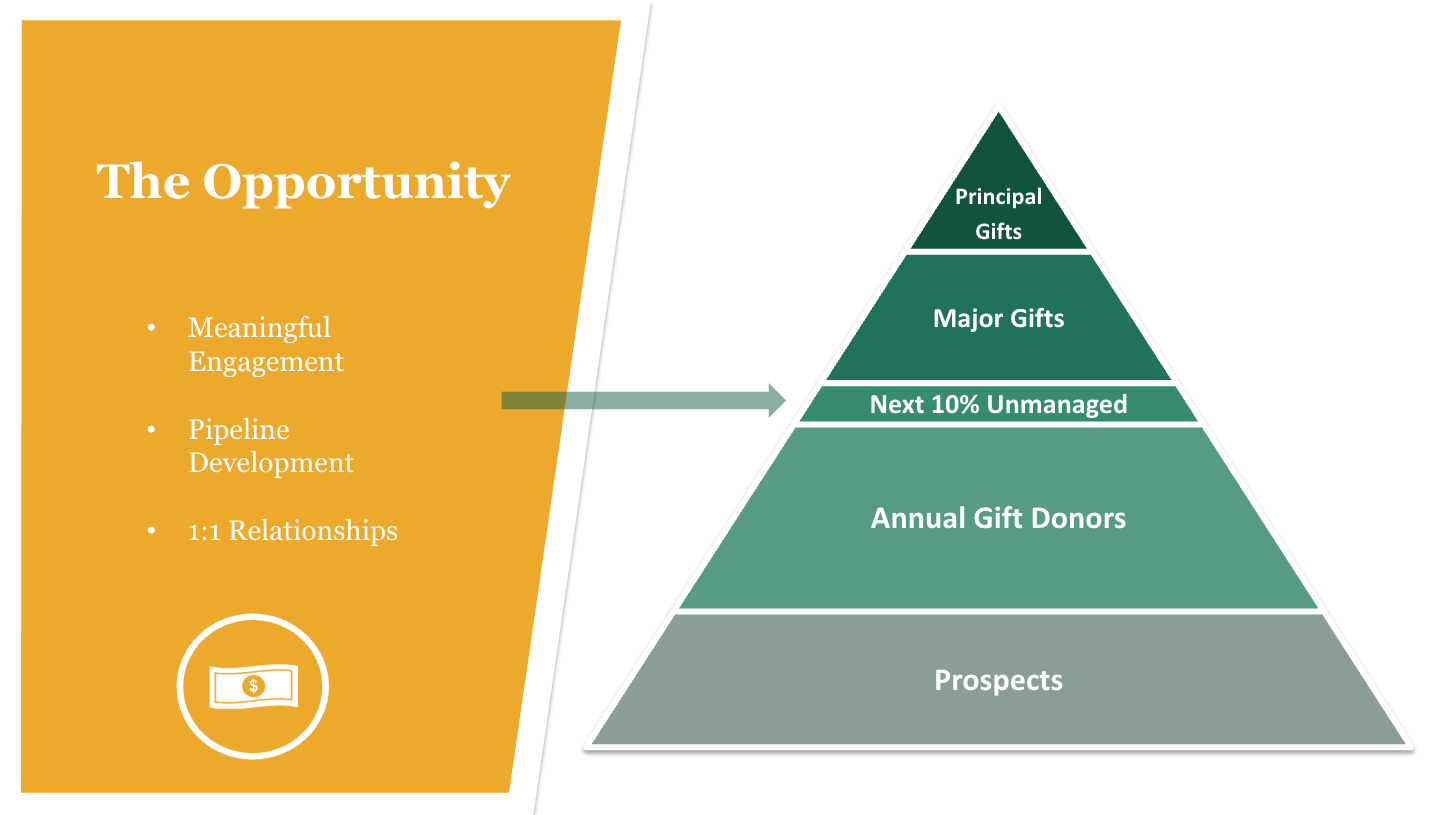
If your advancement structure looks like most, your donor pipeline has a gap right where momentum should be building.
At William & Mary, that gap showed up as the “next 10%,” a segment of donors sitting between annual giving and major gifts—largely unassigned and under-engaged.
These are not fringe donors. They are:
- Consistent annual supporters
- Donors with increasing capacity
- Alumni with clear affinity but limited personal engagement
So why do they get stuck? In many cases, it comes down to simple (and familiar) realities:
- Gift officer portfolios grow too large to manage effectively
- Travel-based models limit how many relationships can be maintained
- Outreach becomes sporadic—sometimes reduced to a single email each year
- Without clear ownership, donors quietly fall between teams
Over time, these constraints create a segment of donors who are known to the institution, but not meaningfully engaged by it. They have capacity, but no relationship strategy guiding them forward.
This is where DGOs create value. By combining structured outreach with personalized engagement, they bring consistency and ownership to a part of the pipeline that is often overlooked. And in doing so, they help ensure that more donors continue moving forward rather than stalling out. At William & Mary, that structure was enabled by a Digital Gift Officer model supported by GiveCampus.
Before You Build the Team, Build the Case
Many institutions are eager to start hiring as soon as the idea of a DGO program gains traction. William & Mary took a more deliberate approach.
They began by clearly articulating the business need: closing the gap between annual giving and major gifts.
That framing matters because it makes alignment across advancement far easier—and alignment is essential.
Launching a DGO program requires coordination across:
- Senior advancement leadership
- Prospect development
- Annual giving
- Major gifts
William & Mary also made an early decision to build the program in partnership with GiveCampus, which allowed them to accelerate implementation while building internal capacity.
The takeaway is straightforward: without shared understanding and buy-in, even well-designed programs may struggle to gain traction.
What it Takes to Build a DGO Program
Standing up a successful DGO program takes time—and intention. At William & Mary, the team spent more than a year building the foundation before fully launching outreach.
One of the most important early decisions was organizational placement. William & Mary chose to house the DGO team within annual giving, reflecting how they defined the role from the outset: focused on engaging and qualifying donors who were not yet ready for major gift portfolios.
That structure reinforced the team’s role in building relationships at scale, while still requiring close coordination with major gifts to ensure smooth handoffs and shared visibility into donor movement.
More broadly, the timeline reflects a deliberate focus on getting the fundamentals right before outreach begins. That includes:
- Clean, reliable data
- Thoughtful portfolio design
- Clear processes and documentation
- Internal clarity on roles and collaboration
Consistent, scalable outreach starts with getting these fundamentals right.
At this point, the question becomes less about why to build a DGO program—and more about how to make it work in practice.
For Meghan Palumbo, that perspective is shaped by nearly 15 years in advancement, with experience spanning annual giving, major gifts, and both central and unit-based roles. That range shows up clearly in how William & Mary designed its approach: practical, structured, and built to operate within the realities of a complex advancement organization.
What a High-Performing Digital Gift Officer Team Looks Like
The William & Mary DGO program was built deliberately, with a clear progression from planning to hiring to early performance.

After nine months of internal alignment, data preparation, and portfolio strategy, the team hired three DGOs in late 2023 and began outreach shortly thereafter.
The hiring process focused on candidates who could operate effectively in a digital-first, high-activity environment. That meant prioritizing individuals who were:
- Strong communicators across channels (not just in-person)
- Comfortable managing large portfolios and structured workflows
- Able to balance personalization with consistency
- Aligned with annual giving’s pace and production expectations
In parallel, the team built the infrastructure those DGOs would need to succeed, including:
- Clearly defined portfolios
- Standard operating procedures (SOPs) and documentation
- Established partnerships across advancement teams
- A shared understanding of goals, metrics, and expectations
Documentation was developed with continuity in mind. As the team refined its approach, processes were captured and standardized so that future hires could step into established workflows and ramp more quickly. The goal was to ensure that when team members moved into new roles, the next group could pick up where they left off rather than rebuilding the program each time.
By the time outreach began, the team was operating within a clearly defined system—making it easier to focus on execution from day one.
Within the first month, the focus was on building consistent activity:
- Launching cadence-based outreach across all portfolios
- Introducing themselves to donors through personalized email and video
- Beginning qualification work to better understand donor interest and capacity
- Building daily habits around consistent, multi-channel engagement
As that consistency took hold, results followed.
Within the first six months, the team generated more than $700,000 in revenue—an early indicator that donors were responding to a more structured and personalized approach.
From there, the team settled into a steady operating model:
- Portfolios of approximately 1,000 households per DGO
- Around 150 visits annually (primarily virtual)
- Approximately 600 solicitations, including 150 substantive conversations

What stands out is how quickly the team moved from launch to productivity. Because hiring, portfolio design, and operational structure were aligned from the start, DGOs were able to focus on execution almost immediately.
For advancement leaders, the takeaway is clear: strong early performance is rarely accidental. It’s the result of thoughtful hiring, clear expectations, and a system that supports consistent execution.
Portfolio Strategy: The Quiet Make-or-Break Factor
At William & Mary, developing a portfolio strategy was a deliberate, data-informed process built in close partnership with prospect development and major gifts.
The team focused on identifying donors already showing signals of both affinity and capacity, including:
- Consistent giving history (not just one-time gifts)
- Annual giving levels typically in the $200–$10K+ range
- Higher-capacity donors not yet assigned to major gift portfolios
This ensured DGOs were focusing on donors with real potential—not trying to generate interest from scratch.
Just as important as the criteria was the collaboration behind it.
Portfolio creation included active input from prospect development, to validate ratings and identify qualified prospects, and from major gifts, to ensure alignment on who should remain in MG portfolios. That upfront alignment helped avoid one of the most common pitfalls in DGO programs: tension over ownership.
Prioritization Is Ongoing
Once portfolios are built, the work shifts to prioritization. DGOs adjust focus throughout the year based on strategic priorities and donor context.
At the start of the fiscal year, that includes:
- Reviewing the prior year’s data and performance
- Removing disqualified prospects and adding new ones
- Reassessing portfolios based on updated capacity and engagement signals
- Refining outreach cadences based on what worked (and what didn’t)
From there, attention shifts to key segments tied to the advancement calendar—particularly reunion cohorts. For example:
- Donors in 4- and 9-year reunion cycles
- Donors in 0- and 5-year milestone years
These groups receive more targeted outreach, often in coordination with reunion teams to ensure consistent messaging and timing.
A 12-Month Plan That Aligns with the Institution
This creates a rolling, 12-month strategy rather than a static portfolio. Throughout the year, DGOs:
- Rebalance portfolios as donors engage (or disengage)
- Align outreach with institutional moments
- Coordinate across teams to ensure cohesive communication
- Adjust cadence and messaging based on real-time response
The result is a portfolio strategy that evolves alongside the donor.
A Practical Check for Existing Programs
For teams with an existing DGO program, this is often one of the highest-leverage areas for improvement.
If performance is lagging, it’s worth asking, are you:
- Actively reprioritizing throughout the year—or working the same list the same way?
- Aligning outreach with key institutional moments?
- Using data from prior cycles to refine our approach?
In many cases, refining how portfolios are managed over time can unlock more impact than changing outreach tactics.
DGO Outreach Cadences: How to Scale Donor Relationships
At the core of William & Mary’s DGO program is a disciplined approach to one-to-one outreach, built around cadences.
A cadence is a structured sequence of personalized touchpoints that guides how and when DGOs engage each donor. These engagement tracks provide a clear framework for outreach, helping ensure consistency while still allowing for personalization.
At William & Mary, these cadences are designed for different stages of the relationship, including:
- Qualification (introducing the relationship and gauging interest)
- Stewardship (deepening engagement and demonstrating impact)
- Solicitation (making timely, informed asks)
Each cadence includes a mix of channels—email, phone, LinkedIn, text, and personalized video—sequenced intentionally to build familiarity and response over time.
This is where technology plays a critical role.
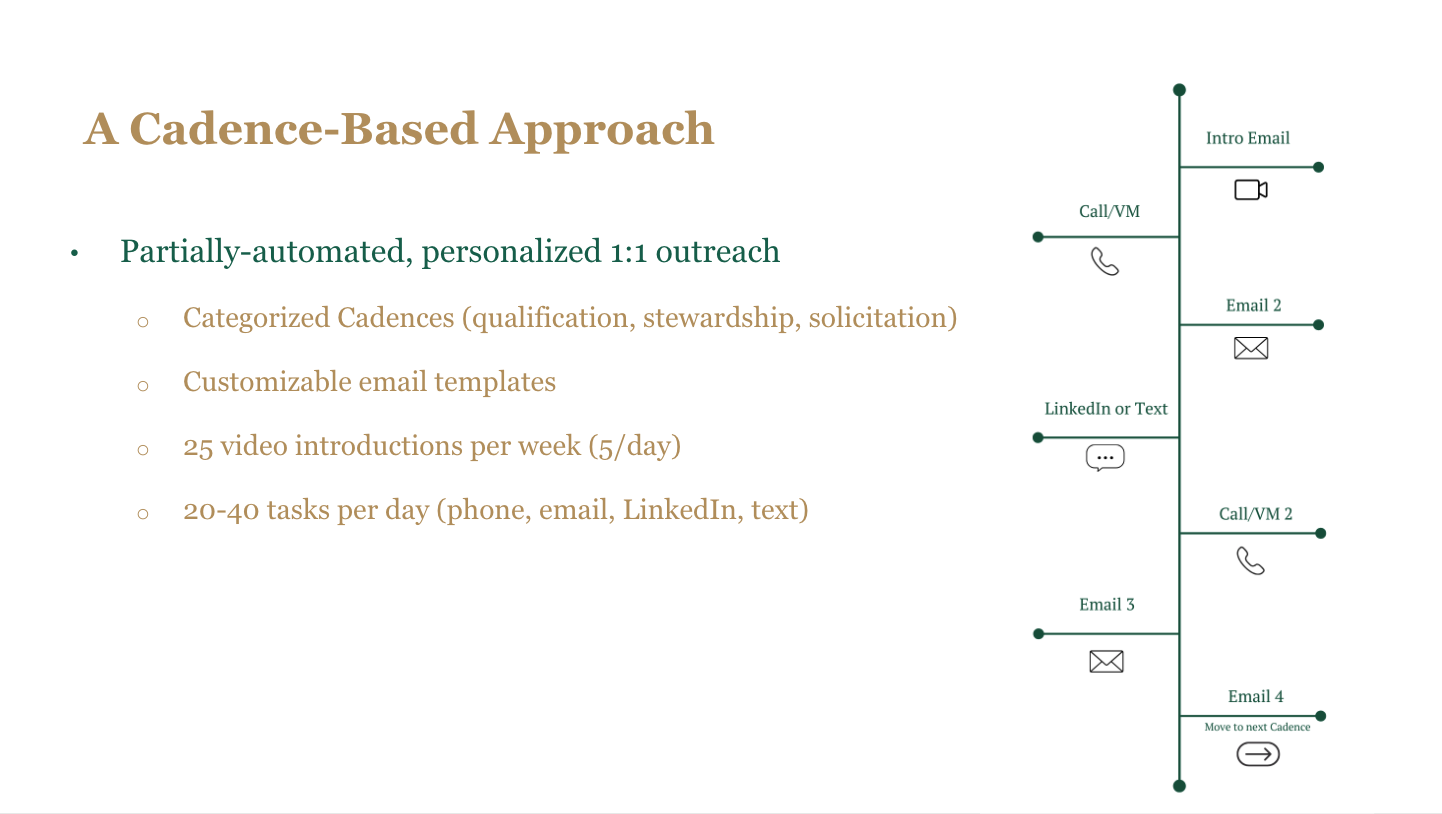
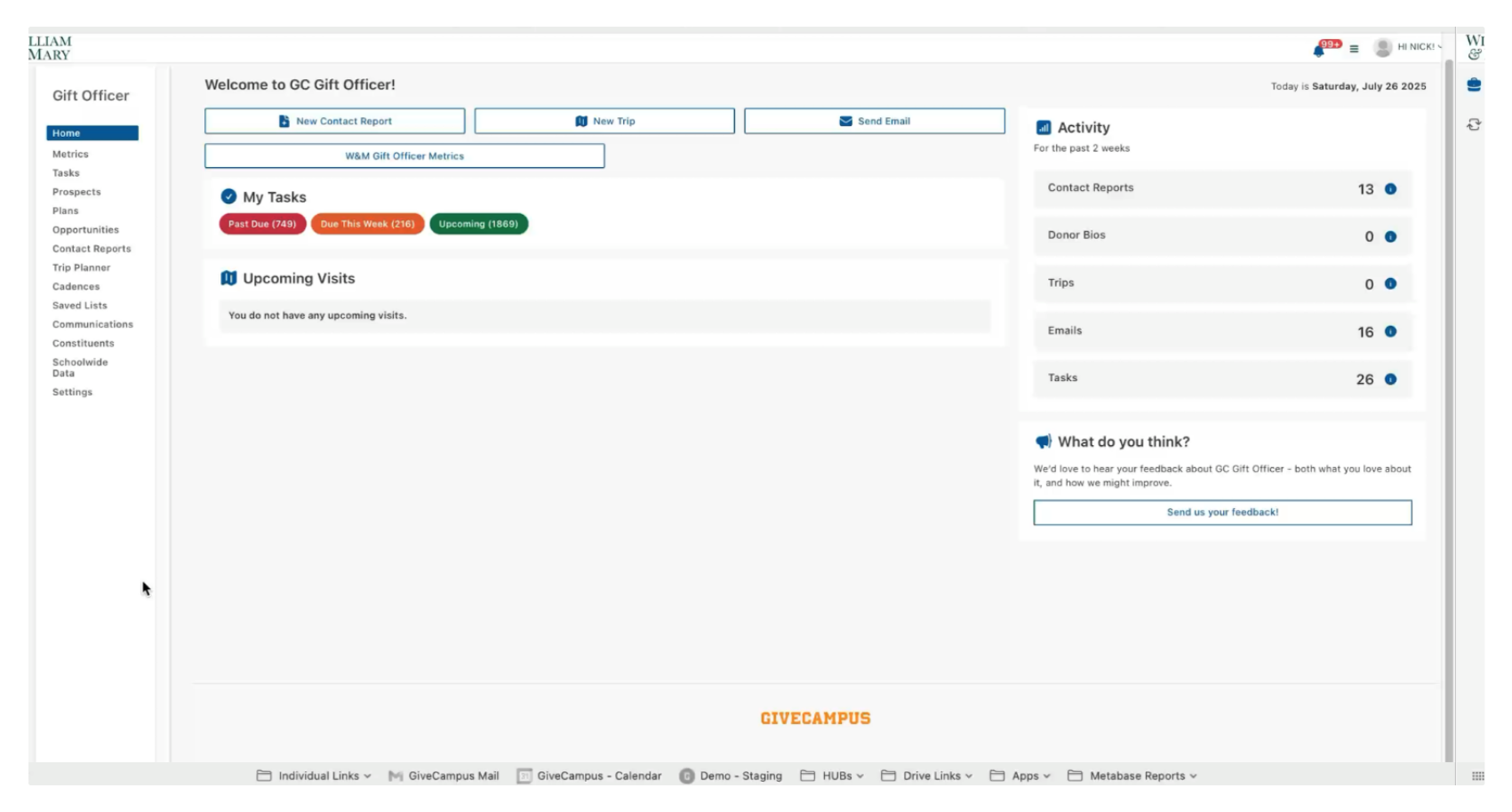
Using GC Gift Officer, DGOs are guided by structured cadences. The platform organizes daily outreach tasks, tracks engagement, and ensures that no donor falls through the cracks.
Instead of deciding who to contact each day, DGOs are guided by a system that prioritizes outreach based on cadence stage and donor behavior.
In practice, that translates to:
- 20–40 outreach tasks per day
- Consistent, multi-channel engagement across portfolios
- Approximately 25 personalized video messages each week
The structure is important because it reflects a simple reality: most donors don’t respond to a single touchpoint. Meaningful engagement is the result of sustained, thoughtful outreach over time.
Cadences make that possible.
They create consistency without sacrificing personalization, giving DGOs a clear framework while still allowing room to tailor each interaction. And over time, that consistency compounds—turning initial outreach into conversations, and conversations into giving.
Cross-Team Collaboration Drives Pipeline Movement
For a DGO program to succeed, it has to be fully integrated with the rest of advancement.
At William & Mary, that integration is intentional and structured. The program relies on close collaboration with data services, prospect management, major gifts, and regional teams—supported by a shared understanding that pipeline development is a collective responsibility.
One of the most important mechanisms for that collaboration is a monthly pipeline committee.
This group includes representatives from annual giving, prospect management, regional leadership, and senior advancement leaders. Together, they review portfolios and make decisions about donor movement across the pipeline.
Those conversations are specific and action-oriented:
- Identifying donors in DGO portfolios who are ready to move to major gifts
- Discussing whether those donors should be reassigned to regional or unit-based MGOs
- Reviewing major gift portfolios to identify donors who may not yet be ready for that level of engagement
In some cases, that means moving donors up. In others, it means moving them back into a DGO portfolio for further cultivation.
A guiding principle helps keep these decisions clear: if a donor is not positioned to make a major gift—or is unlikely to do so within the next few years—they may be better served through a different engagement strategy.
This regular cadence of review ensures that portfolios remain active and aligned. It also creates shared ownership across teams, reducing friction and improving trust over time.
That trust is essential. Without buy-in from major gifts, prospect development, and data teams, the DGO model doesn’t function effectively. With it, donor movement becomes more intentional—and far more consistent.
What Success Actually Looks Like
At William & Mary, success shows up in both individual donor outcomes and overall program performance.
Some of the most compelling results are rooted in how relationships develop over time:
- A donor who increased giving from $5K to $25K+ through consistent email engagement
- A $150K endowment gift that began with a one-hour phone conversation
- A $137K planned gift developed through a mix of digital and in-person engagement
These examples reflect an important shift: donor relationships are no longer defined by a single channel. When outreach is consistent and intentional, DGOs can build trust—and drive results—across a range of touchpoints.
That relationship-building translates directly into measurable impact.
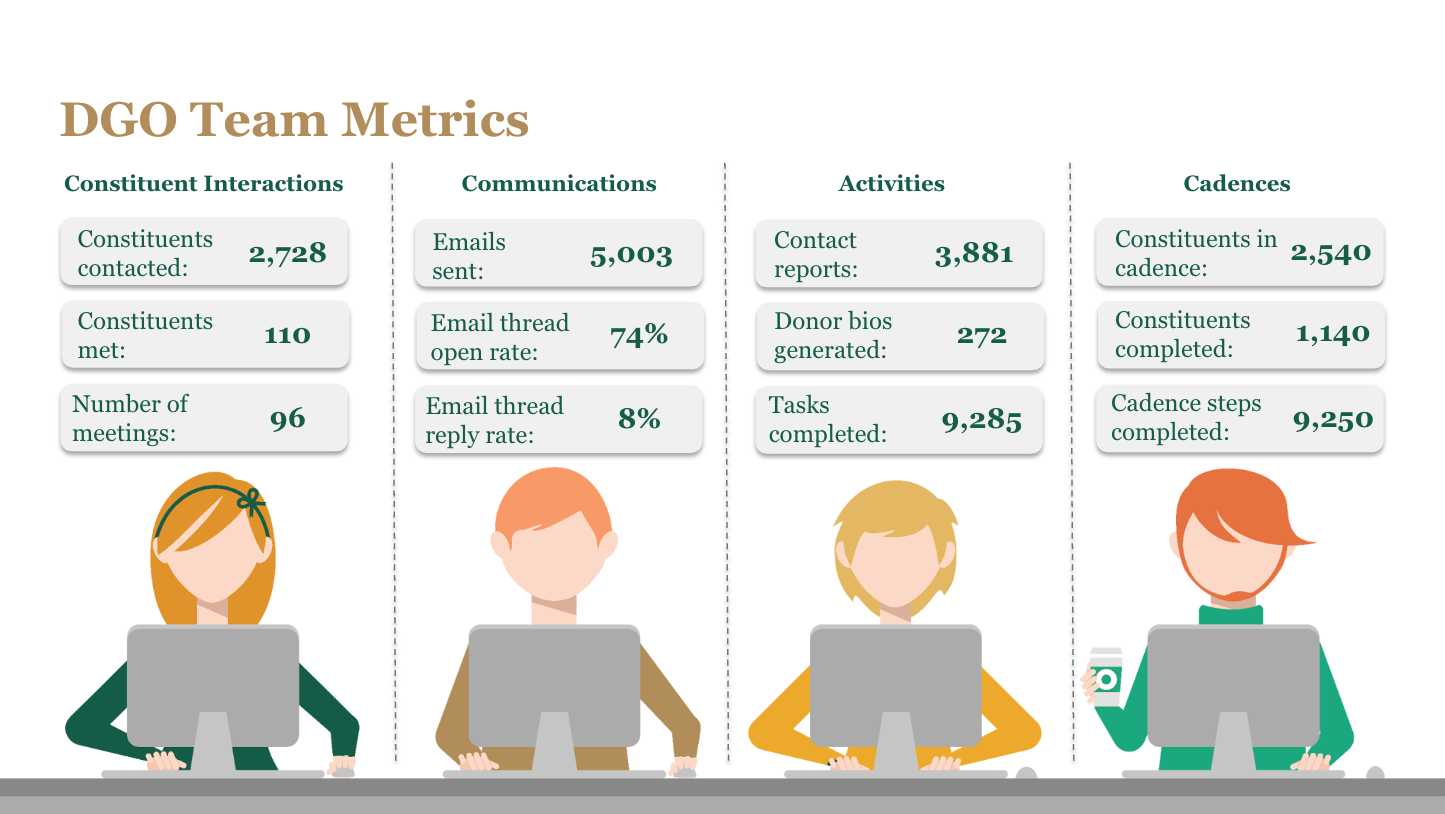
In less than two years, the DGO program has generated more than $3.1 million in revenue, alongside:
- 1,300+ solicitations
- 17,000+ activities
- 600+ visits
Beyond the headline numbers, the program has strengthened donor retention, improved qualification, and created a more reliable pipeline for major gifts. Those individual outcomes add up quickly.
A Strategic Partnership to Accelerate Execution
While the DGO model at William & Mary is deeply rooted in internal strategy and alignment, its success has also been supported by a strong partnership with GiveCampus.
This was not a short-term or transactional decision. William & Mary has worked with GiveCampus over time, building familiarity and trust that made it easier to expand into the GC Gift Officer platform as their DGO strategy took shape.

As the team moved from planning to implementation, GiveCampus provided both the technology and the strategic support needed to bring the program to life. The platform enabled DGOs to manage portfolios, execute cadence-based outreach, and track engagement in a way that would have been difficult to replicate manually.
Just as importantly, the partnership extended beyond the platform itself.
William & Mary benefited from:
- Ongoing guidance on DGO strategy and best practices
- Support in building and refining cadences
- Insight into how peer institutions were approaching similar challenges
- A collaborative approach to iteration as the program evolved
This combination of platform and partnership helped the team move more quickly from concept to execution, while avoiding many of the common pitfalls that come with launching a new fundraising model.
For institutions exploring a DGO program, this underscores an important point: success depends not only on internal alignment, but also on having the right external support to accelerate learning and implementation.
How to Start (or Strengthen) Your Own DGO Program
For teams looking to build or refine a DGO program, several principles stand out:
- Establish alignment across advancement early
- Focus on your most promising unassigned donors
- Implement structured outreach cadences from the outset
- Balance scale with personalization
- Continuously refine your approach
- Document processes to support long-term consistency
It’s also worth being intentional about where the team sits organizationally. At William & Mary, the DGO team was placed within annual giving to reflect its role in broad-based engagement and early-stage pipeline development. Other institutions may make a different choice, but the key is alignment: the reporting structure should reinforce how you expect the team to operate and how it will collaborate with major gifts.
The Bigger Picture: Where DGOs Fit in the Future of Advancement
As advancement programs continue to evolve, the expectations placed on teams are changing.
Portfolios are growing. Donors expect more personalized engagement. Travel-based models alone are becoming harder to sustain at scale.
DGOs provide a way to meet these demands by strengthening the middle of the pipeline and ensuring that more donors receive meaningful, consistent attention.
For many institutions, the question is no longer whether this model has value. It’s how quickly it can be implemented effectively.
Ready to build your own high-performing DGO program?
See how GC Gift Officer helps teams manage portfolios, execute personalized outreach at scale, and move more donors through the pipeline.