Agentic AI Fundraising Doesn’t Mean All or Nothing Control
Jun 2026 - READ IN 5 MINUTES

Advancement teams are under real pressure to do more with less. Portfolios keep growing, goals keep climbing, and headcount rarely keeps pace. But the heart of fundraising hasn’t changed: gifts come from real relationships between a fundraiser and a donor, built over time through genuine human connection. That’s the work that should get a fundraiser’s best hours, and it’s exactly the work that gets squeezed when a team is stretched across a portfolio it can’t fully cover.
Then there’s artificial intelligence (AI). The promise is compelling: deploy AI and finally get full coverage of a portfolio that has been outrunning your team for years. But when advancement teams go to implement it, they run into a narrower set of options than the hype suggests. Many of the agentic fundraising tools entering the market work like a switch: one setting, full automation, with no review and no visibility into what the agent decided or why.
A switch asks you to answer a question you shouldn’t have to answer, and to answer it in absolutes: either you trust an AI agent with your donor relationships, or you don’t.
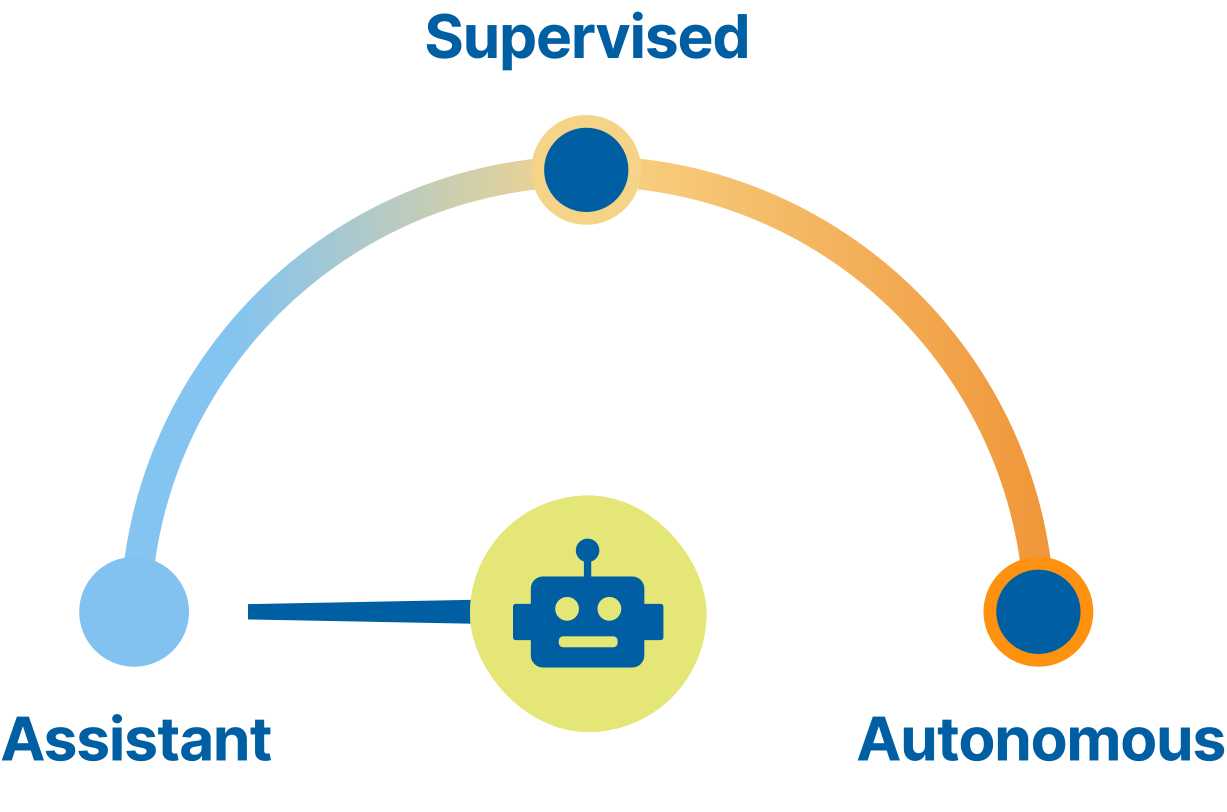
Most advancement leaders we talk to don’t live at either end of that question. They start out cautious, want to see the work before it goes out, and get more comfortable as the agent earns their trust over time. What they’re really asking for is a dial. A switch has two positions: on or off. A dial has a full range in between, and you can rest anywhere on it, moving it up or down as trust builds.
GC GO Agent works as a dial. You set the goal, whether that’s cultivation, stewardship, engagement, or solicitation, then set how much the agent does on its own. You can move that setting whenever you want.
How the dial works
The dial moves across three settings, each one a different balance between what the agent does on its own and what you see before it executes:
- Assistant: The agent researches the segment, designs the cadence, and drafts every message. Nothing sends without your explicit approval, one message at a time. This is where most schools start.
- Supervised: You review a sample of the agent’s work, edit it, and give feedback. The agent learns from that sample and operates inside the boundaries you approved. Scenarios you flag still escalate to you before the agent acts.
- Autonomous: The agent drafts, sends, and responds on its own. You still set the goal, the rules of the road, and the escalation triggers, and you still see everything, but the agent doesn’t wait on you.
None of this is a one-time decision. Schools move along the dial as the agent earns confidence, and they can move back just as easily. The right setting for a mid-level stewardship program is often different from the right setting for a reunion campaign, and one school can run both at the same time with different agents at different positions on the dial.
In every mode, you see each message the agent sends and every conversation it has. And each message is personalized and written in your institution’s voice, powered by GC Intelligence, rather than blasted out from a template.
Agentic fundraising that runs on your data
The reason that personalization holds up is the data underneath it. GC GO Agent runs on your live GiveCampus data: giving history, event registrations, volunteer activity, contact reports, and wealth and career signals. It isn’t guessing at who someone is or pulling from a thin external profile.
This is the difference between GC GO Agent and standalone AI outreach products. Those tools sit outside your CRM and have no access to your actual constituent record, so the outreach they generate is generic by necessity. An agent working from a constituent’s real giving history, event attendance, and engagement signals can write something that reflects that relationship. One working from a thin external profile cannot. When you’re evaluating tools, that’s the difference worth asking about.
You stay in control when a constituent responds
The moment that makes most advancement leaders cautious about AI outreach is the reply. A constituent writes back, and suddenly there’s a live conversation that could go anywhere.
GC GO Agent puts that moment under your control. When you set up the agent, you set the escalation rules. You can have it pause and notify a human any time a constituent replies, makes a gift, or crosses any threshold you define. A reply that comes back in a negative tone, or a gift far larger than the last one, can route straight to a person. From there you decide whether the agent keeps the conversation going or a fundraiser steps in, and you can hand the constituent back to the agent later. The agent never has to be the one carrying a high-stakes conversation unless you want it to.
What agentic fundraising is good for
The reason that personalization holds up is the data underneath it. GC GO Agent runs on your live GiveCampus data: giving history, event registrations, volunteer activity, contact reports, and wealth and career signals. The agent isn’t guessing at who someone is or pulling from a thin external profile.
This is the difference between GC GO Agent and standalone AI outreach products. Those tools sit outside your CRM and have no access to your actual constituent record, so the outreach they generate is generic by necessity. An agent working from a constituent’s real giving history, event attendance, and engagement signals can write something that reflects that relationship. One working from a thin external profile cannot. When you’re evaluating tools, that’s the difference worth asking about.
GC GO Agent is a standalone product, so your team doesn’t need to be running GC Gift Officer to put an agent to work. The two are built to work together when you are.
AI that helps you scale your fundraising
GC GO Agent fits into your team on your terms. Ask it to draft outreach for your review and it does that. Ask it to run a full sequence end to end and it does that too. You set the rules, you own every escalation decision, and you can move the dial at any time.
The constituents who used to wait indefinitely now hear from the school in a timely fashion, the gift officer’s bandwidth goes further, and the conversations that need a human still get one.
If you’re interested in how GC GO Agent might help you expand your team’s reach, schedule time with us.
Frequently asked questions
What is agentic fundraising?
Agentic fundraising is an approach to donor outreach in which AI agents act on behalf of a fundraiser, initiating contact, following up, and responding to replies, rather than simply generating content for a human to send. The agent operates within parameters the fundraiser sets, but it executes on its own. The distinction from basic AI tools is autonomy, because the agent doesn’t wait to be prompted.
How is AI used in fundraising?
AI helps advancement teams reach more of their portfolio without adding headcount. AI drafts personalized outreach from a constituent’s giving history and engagement signals, recommends who to contact and when, and can run entire outreach sequences when a team wants it to. The goal isn’t to replace fundraisers. The goal is to handle the outreach that might otherwise never happen, so gift officers can spend their best hours on the relationships that need a human.
What fundraising processes can be automated with AI?
AI can automate prospect identification and prioritization, surfacing mid-level donors ready for deeper engagement and flagging lapsed donors worth re-engaging. AI can also handle much of the outreach that surrounds a gift: stewardship follow-up after a giving day, event and reunion invitations, re-engagement of LYBUNTs and SYBUNTs, and warming up prospects before a fundraiser steps in. AI can draft messages for review, personalize them at scale, and escalate replies to a human the moment a conversation matters. What AI shouldn’t automate is the high-stakes, relationship-defining moments, because those still belong to a person.
What’s the difference between AI-assisted and autonomous fundraising?
The difference is how much the AI does on its own, and the better products treat that as a range rather than a single choice. AI-assisted fundraising keeps a human in the loop, so the AI drafts and a fundraiser reviews and approves before anything sends. Autonomous fundraising hands the full sequence to the agent, which drafts, sends, and responds on its own within the rules you set. GC GO Agent runs across that whole range. Assistant mode holds every message for your approval, Supervised mode lets the agent work inside boundaries you review and approve up front, and Autonomous mode runs the sequence end to end. You choose where to sit, and you can move at any time.