Alumni Events Best Practices: Your Complete Playbook for Engagement, Fundraising, and Impact
Jun 2026 - READ IN 13 MINUTES

Reunions and events are now the top alumni engagement strategy at 50 percent of higher ed institutions, ahead of alumni boards, annual giving campaigns, and giving days, according to the 2026 CCS Philanthropy Pulse. And yet, despite that investment, only 19 to 20 percent of alumni at any given institution are engaged in any meaningful way—a figure that has held flat for three consecutive years, per the most recent Insights on Alumni Engagement report from the Council for Advancement and Support of Education (CASE).
That gap—between the effort going in and the engagement coming out—is what this alumni events best practices guide addresses.
What follows covers 10 practices for running better alumni events: from registration and fundraising to auctions, AI-assisted engagement, and post-event stewardship. The examples come from schools of every size and type—independent schools, small liberal arts colleges, community colleges, and large research universities—because the fundamentals hold regardless of institution.
1. Make it easy to register
Your event page is your first impression, and for many alumni, it’s the deciding factor on whether they RSVP at all.
According to CASE’s Insights report, alumni who participate in experiential engagement—attending events, showing up on campus, gathering with classmates—give philanthropically at more than twice the rate of those reached only through communications. The registration experience is where that chain either starts or stalls.
The bar is high. Your alumni are digital consumers who book flights, order dinner, and buy concert tickets in under two minutes. A clunky RSVP flow, a page that breaks on mobile, or a checkout that asks too many questions will cost you registrations—quietly, with no feedback.
The goal is a page that makes a complex event feel easy to navigate. Blair Academy’s annual Alumni Weekend includes a golf scramble, a pickleball tournament, campus tours, an Athletic Hall of Fame induction, an alumni softball game, class-specific receptions, and ticketed meals across all three days—including a meal pass that covers everything from Friday lunch to Sunday brunch.
Guests can also reserve on-campus dorm rooms, register for childcare, and add individual activities à la carte. Yet the event page manages to organize every detail clearly, so the path from “interested” to “registered” stays short regardless of how many options a guest selects.

Build a high-performing event page
Every event page—from a simple regional happy hour to a complex homecoming weekend—benefits from the same core elements: an inviting hero image, event details at a glance, a countdown clock, clear call-to-action buttons, easy social sharing, and a public guest list so prospective attendees can see who else is coming before they commit. Blair Academy’s page checks every box.
Tailor the experience to who’s registering
Not every attendee at your event is an alum. A homecoming weekend might draw parents, faculty/staff, current students, and friends of the institution—each with different ticket options and information needs. In GC Events, Registration Paths let you tailor the registration experience based on what someone selects during checkout—like affiliation—so registrants (and, when needed, their guests) see only the ticket types, activities, add-ons, and questions that apply to them. The result is a cleaner, faster RSVP flow—because people aren’t wading through options that were never meant for them.
2. Factor in fundraising
Registration and giving go together naturally—and the numbers bear that out.
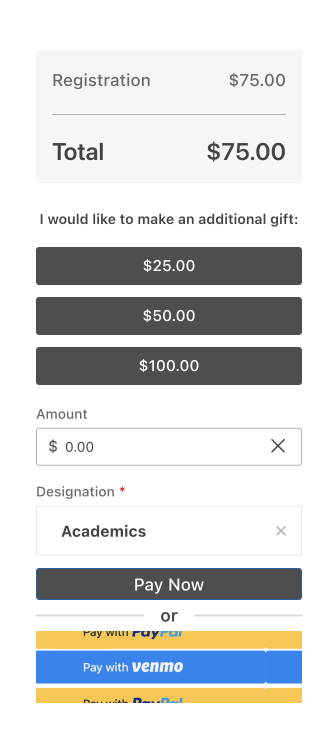
On average, 13 percent of alumni who register for an event on the GiveCampus platform make a gift at the same time, with an average gift of $95. That giving happens because the opportunity is there, visible, and easy to act on at the moment of highest intent: when someone has just decided to show up.
There are two natural places to make the ask: a donation button on your event page for alumni who want to give before they register, and a giving prompt at checkout for those who decide in the moment. Many schools use both. Hackley School put a MAKE A REUNION GIFT button directly on their Alumni Day event page. The result: 21 percent of registrants made a gift—up from 9 percent the year before.

Hackley’s experience reflects a broader pattern. Across the GiveCampus platform, 82 percent of alumni who give at an event are first-time donors to their institution. For advancement teams focused on donor acquisition, events may be the most undeutilized channel in their portfolio.
High giving rates at events hold across institution types. Finger Lakes Community College routinely sees 19 percent of event registrants make a gift during registration. And, over the course of 18 months, the University of San Diego generated $68,000 through donation integration alone.
Create giving opportunities on the day of the event
The events team at Quinnipiac University recommends using trackable QR codes for walk-up registrants at student-focused events. QR codes placed at check-in tables, on printed programs, or at activity stations give attendees a frictionless path to a giving form or fundraising campaign without requiring staff to make a direct ask.
A mobile card reader is another option, particularly at homecoming weekends and athletic events where the energy (and attendance) is high. Look for a Bluetooth-enabled reader so you’re not hunting for a power outlet or Ethernet cable in a tent.
3. Offer time-bound incentives and multiple ticket types
Early bird pricing and promo codes are often framed as perks for guests, but they’re also planning tools for you.
The sooner registrations come in, the sooner you can confirm headcount with your venue, finalize catering, schedule activities, and brief volunteers. Getting people to commit early isn’t just good for revenue—it’s the difference between running an event and scrambling to produce one.
A discounted early-bird rate, a deadline visible on the event page, and a countdown clock do most of the work. Promo codes let you give specific groups—reunion classes, board members, loyal volunteers—a private rate without making it public. Multiple ticket types let you match price to access: a general admission ticket, a VIP table, a sponsorship package, a branded item add-on.
The University of La Verne’s recent Scholarship Gala put this into practice at scale. The annual black-tie-optional dinner offered individual tickets, tables, and sponsorship tiers—each with distinct pricing and inclusions. Guests could select exactly what they wanted in a single checkout, with no back-and-forth with the advancement office to confirm their package.
Flint Hill School’s Golf Invitational and Skills Social took a different approach to the same principle. The independent school in Oakton, Virginia offered five distinct ways to participate—an 18-hole scramble, a skills clinic, volunteering, a standalone activity registration, or just ordering the branded Peter Millar polo—all within one simple event page. Guests who weren’t golfers still had a reason to register. Proceeds benefitted the school’s financial aid endowment, which gave every ticket type a clear philanthropic purpose.
4. Get creative
Alumni engagement doesn’t have to be anchored to a campus or a milestone year. The advancement teams generating the most interest—and the most registrations—are finding ways to meet alumni where they already are, in moments that feel relevant to their lives right now.
The right event format depends on who you’re trying to reach. Loyal supporters and major donors tend to respond better to smaller, more intimate gatherings where individual attention is possible. Newer or younger alumni often engage more readily with low-pressure events where the ask, if there is one, isn’t front and center.
Geographic spread matters too—a virtual event can reach alumni who haven’t been back to campus in years, at no cost to either party. And demographic differences in scheduling are real: alumni past retirement age are more likely to attend daytime events on weekdays than young working professionals. Once those parameters are clear, the format follows.
Collaborate across campus
If you’re not already in regular contact with your colleagues in student affairs, start there. Faculty lectures, visiting speakers, and athletic milestones, are all potential pegs for alumni programming—including virtual options that let geographically dispersed graduates participate without traveling.
Build excitement around a cultural moment
When the Professional Women’s Hockey League (PWHL) scheduled its first-ever game at Madison Square Garden, Colgate University saw an opportunity. Six former Raiders were on the two competing rosters combined—including Kristýna Kaltounková, the No. 1 overall pick in the 2025 PWHL Draft. The Colgate alumni office organized a NYC PWHL Takeover around the sold-out game, giving New York-area alumni a reason to gather around a moment that was already generating excitement. No campus required, no milestone necessary—just a timely hook and a room full of people with something in common.

Run a coordinated national series
McCallie School, a boarding and day school in Chattanooga, Tennessee, ran a week-long McCallie Across the Nation event that brought alumni together in nine cities. Each gathering was low-key—a relaxed evening at a local venue with familiar faces—but the coordination across cities gave the week a sense of shared momentum. Alumni in Atlanta, Knoxville, and seven other markets were part of the same event, even if they never crossed paths.
Let the calendar inspire you
Stockton University hosts an annual Faculty Forum series that invites alumni to join virtually for a one-hour conversation with a faculty expert. For July 2026, the team scheduled Sharks: Myth and Reality to coincide with Shark Week, featuring a faculty discussion on the complex mythology of sharks and their largely inaccurate portrayal in popular media. Free, virtual, and timed to a moment already on people’s radar—it’s a low-lift event with a built-in reason to show up. It’s worth scanning your programming calendar regularly.

5. Drive engagement
Well-run alumni events build momentum well before anyone sets foot on site—and keep it going after the last guest leaves. The registration page, the guest list, the social share buttons, the recap email: each one is a touchpoint that can extend the reach of your event and deepen the connection alumni feel to your institution.
Salesianum School’s 2026 Alumni Golf Outing shows how a single event page can do a lot of this work automatically. The public guest list lets prospective registrants see exactly who’s coming before they commit—a quiet but effective driver of sign-ups, particularly for an event built around foursomes where you want to play with people you know.
Social share buttons for Facebook, X, and LinkedIn sit directly on the details page, making it easy for registrants to spread the word with one tap. The sponsorship packages—seven tiers ranging from a $250 hole sign to a $10,000 presenting sponsorship—each include social media recognition and a post-event recap, which means the event has planned promotional touchpoints built into its revenue model before a single round is played.

Use registration to capture data that drives follow-up
At Quinnipiac University, event registration captures class year, affinity group, email, and cell phone—data that shapes staffing decisions, informs messaging, and makes post-event follow-up more relevant.
Within 24 hours of each event, Quinnipiac sends a photo recap to the full invitee list. Alumni who didn’t attend see what they missed, and the message plants a seed for next time.
Keeping that communication going—without it becoming a manual burden—is where an integrated email tool earns its keep. With GC Events Sequences, you can automate your entire event communication lifecycle from one place: an invitation to your full invite list, a reminder to everyone who hasn’t registered yet, a day-of message to confirmed attendees, and a targeted follow-up after the event ends. Because Sequences runs inside GC Events, your audience filters are already built from your registration data—you can send one message to attendees who gave and a different one to attendees who didn’t, without exporting a single list or switching tabs.

For a deeper look at how Quinnipiac runs 90 events a year with a lean team, read the full Master Class.
6. Raise the stakes with auctions
Alumni events are already your highest-engagement touchpoint. According to CASE’s Insights report, alumni who participate in experiential engagement give philanthropically at 33.2 percent—compared to 20.9 percent for those reached only through communications. An auction takes that energy and gives it a direct fundraising outlet.
The challenge with most auction setups is coordination. A separate platform, a separate checkout, a separate app for guests to download—each additional step is a point of friction that costs you bids and donations. The most effective auction experiences keep guests in a single flow: they bid on their phones, get outbid alerts in real time, complete one checkout for tickets, giving (if enabled), and winning items.
A few features worth looking for in any auction solution:
- Phone-raise bidding. Attendees raise their phones instead of paddles. The system registers the gesture, and donors bid directly from their devices—no app download required. Outbid alerts arrive via SMS and email in real time, keeping bidders engaged throughout the event.
- AI-assisted item entry. Upload a photo of an auction item and the system automatically generates the listing. What used to take your marketing team time in Canva takes seconds.
- One checkout. A donor can register for the event, make a gift, and bid on auction items without ever leaving the platform or re-entering payment information.
GC Auctions—built directly into GC Events for all Partners at no additional cost—is how GiveCampus has approached this. But whatever solution your institution uses, the goal is the same: fewer handoffs, one checkout, and bidders who stay engaged through the last gavel.

Now you can run live auctions, silent auctions, and paddle raises inside GC Events—so ticketing, check-in, giving, and bidding all happen in one place, with a single checkout experience.
7. Expand your reach
Your advancement team can only contact so many alumni directly. Volunteers—class agents, reunion committee members, athletic alumni liaisons—extend that reach significantly, and they do it with something institutional outreach rarely has: a personal relationship with the person on the other end.
Peer-to-peer outreach performs differently than institutional email. Across GC Volunteer Management, volunteer-sent emails average a 64.8 percent open rate, compared to a 21 percent national industry benchmark. And across GiveCampus, constituents are 44 percent more likely to give when they arrive on a giving form via peer-to-peer sharing.
To apply this to events, give your volunteers ready-to-send language and personalized links to your event invitation and registration page, then track performance by channel and messenger—clicks to registrations to ticket sales, donors, and dollars.
The Westminster Schools, a K–12 independent school in Atlanta that uses both GC Volunteer Management and GC Events, has built exactly this kind of integrated approach. “We use GC Volunteer Management as a recruiting tool,” says Tiffany Wooten, Director of Annual Giving. “We tell volunteers, ‘Hey, outreach is super easy—you can recruit peers and track progress.’ Once volunteers come on board, they say, ‘Oh, that was so easy. I’ll do it again.’” The result is a volunteer program that keeps growing—and an events operation that benefits from it. As Assistant Director of Reunion Giving and Engagement Courtney Hunter puts it: “GiveCampus helps us reduce friction and makes things easy for people—whether it’s giving, volunteering, or signing up for events.”
GiveCampus helps us reduce friction and makes things easy for people—whether it’s giving, volunteering, or signing up for events. It sets the stage for success.Courtney Hunter The Westminster Schools
8. Measure success
CASE—which established the education industry’s standard for collecting, reporting, and analyzing alumni engagement data—recommends tracking alumni interactions across four modes: communication, experiential, philanthropic, and volunteer. Institutions that track all four can benchmark their own progress over time, compare against peers, and identify which engagement modes are driving—or missing—desired philanthropic outcomes.
Alumni events generate valuable experiential engagement data, but it often goes unmeasured—and unmeasured data can’t inform the next event. Check-in happens on a clipboard, and reconciliation happens in a spreadsheet three weeks later, if at all. The fix is upstream: in how your event platform connects to the rest of your tech stack.
Modern event platforms that integrate with your CRM and your giving solution can sync registration, attendance, ticket sales, and revenue automatically—giving you clean, current data you can use to measure performance, reconcile money, and export to downstream systems without manual reformatting. If you’re in the market for a new event solution, integration with your system of record is the capability worth prioritizing.
Midway through a recent CRM transition, the University of San Diego realized the native event solution they were planning to launch couldn’t deliver what they needed. They switched to GC Events instead, and found a payoff they hadn’t been looking for: automated CASE Alumni Engagement scoring. Because event registration and check-in data now flows directly into their engagement reporting, their alumni relations team gets real-time insights, which quickly became a selling point for getting other departments across campus onto the same platform.
That kind of data integration changes what’s possible. When you can see that a constituent attended a regional happy hour in October, registered for homecoming in November, and made a gift in December, you have a relationship timeline—not just a transaction record.
Tracking check-in data also gives you a benchmark for attendance quality, not just registration volume. Asheville School’s inaugural Homecoming and Reunion Weekend achieved a 77 percent attendee check-in rate, well above the GiveCampus platform average of 64 percent—a meaningful gap that only becomes visible when you’re actually measuring it.
Beyond attendance tracking, GC Events custom reporting lets admins filter by date range, event, and activity; select and reorder columns; and export data with field aliases mapped to their CRM’s requirements—so uploads to Raiser’s Edge NXT or Salesforce don’t require manual reformatting. Reports can be saved and re-run, which is a real timesaver for teams that produce the same reconciliation exports after every event.
9. Leverage AI to work smarter at every stage
Ninety percent of higher education professionals now use AI personally—and institutions are catching up fast. According to Ellucian’s 3rd Annual Higher Education AI Survey, institutional AI adoption jumped to 66 percent from 49 percent the previous year, with 88 percent of administrators expecting that number to keep rising. Alumni Relations teams are no exception—and the use cases are no longer theoretical.
The most immediate application is audience intelligence. The typical event invitation goes to everyone on a list. AI-assisted segmentation identifies which alumni are most likely to engage—so invitations reach more responsive segments from the start, and follow-up sequences run automatically rather than manually: a nudge to someone who started but didn’t finish registering, a reminder seven days out, another two days before, and a day-of message to reduce no-shows.
When the event includes a giving moment, AI can also personalize the ask. A suggested gift amount tied to an individual’s giving history and capacity converts differently than a generic field. Some platforms let teams send outreach linked directly to personalized giving forms, so the event and the fundraising campaign work as one coordinated effort.
The newest application is at-event preparation. AI agents, like Events Evan, can now generate brief conversational profiles for every registered guest—drawing on affiliation, career history, volunteer activity, and relevant personal details—along with suggested talking points for staff and volunteers. Gift officers and frontline fundraisers walk in with a short list of warm leads and the context to use it. Student volunteers and class agents can do the same. The prep that used to take hours takes minutes.
10. Steward attendees
The event ends. The relationship doesn’t. What happens in the 72 hours after determines whether a first-time attendee becomes a repeat donor—or someone who never hears from you again.
The stakes are real. According to the AFP Fundraising Effectiveness Project, first-year donor retention rates have hovered around 18 percent for years. Most new donors give once and stop—not because they lost interest, but because no one followed up in a way that made them feel seen. Alumni events introduce new and lapsed donors at a higher rate than almost any other engagement channel. The follow-up is where that investment either compounds or evaporates.
A practical timeline: send thank-yous within 24 hours, event recaps within 48, and feedback surveys within 72—or before end of week, whichever comes first. Segment your outreach by attendance status. Attendees, no-shows, donors, and non-donors each deserve a different message. Sending the same email to everyone wastes the data you collected at registration.
The Westminster Schools use GC Outreach to segment post-event communications by registration status, attendance, and ticket type—sending targeted follow-ups without ever leaving the GiveCampus platform.
A message sent only to donors who gave during registration, or only to attendees of a specific session, is personal outreach—and segmentation is what makes it possible. AI-assisted content generation in GC Outreach helps small teams produce that level of personalization at scale, without writing a separate email for every segment from scratch.
For institutions navigating a CRM transition—or those without robust reporting tools—connecting event and outreach data in one place has an added payoff: communications can be filtered directly using registration and check-in data, with no list exports or manual reconciliation.
Perkiomen School, a small boarding and day school in Pennsburg, Pennsylvania, found this to be one of the biggest efficiency gains after expanding their GiveCampus use beyond their Day of Giving to events like Reunion and Alumni Weekend. Instead of juggling multiple systems, their advancement team could filter audiences and send targeted follow-ups—to registered attendees, to event participants, to alumni who hadn’t yet responded—without leaving the platform.
For a closer look at how Perkiomen School—a six-person advancement team managing events across multiple departments—built a sustainable events and outreach program, read the Perkiomen School Master Class.
Ask what worked—and what didn’t
Post-event feedback is worth building into your standard timeline. Keep surveys short—five questions or fewer—and include at least one that explicitly invites criticism. Giving respondents the option to answer anonymously tends to surface problems that face-to-face conversations won’t.
Equally important: debrief with your own team. Schedule it the day after the event while details are still fresh. If the staff responsible for processing gifts and payments are available, include them—they often surface reconciliation and data issues that don’t show up in attendee feedback, and the earlier those get flagged, the easier they are to address.
Put it all together
The schools getting the most out of their alumni events aren’t necessarily the ones with the largest teams or the biggest budgets. They’re the ones treating every touchpoint—the registration page, the giving ask, the post-event email—as part of a connected strategy rather than a series of one-off logistical tasks.
Today, hundreds of schools in the GiveCampus community use GC Events to manage registration and ticketing, send targeted outreach, solicit gifts, and generate reports without ever leaving the platform. And now, they can run their auctions there too.
From a 25-person regional happy hour to a 5,000-person homecoming weekend, the fundamentals are the same: make it easy to show up, make it meaningful when people do, and don’t let the momentum stop when the lights go down.
Ready to run more impactful alumni events? See GC Events in action.