The Gift Officer’s Fiscal-Year-End Checklist: How to Close More Gifts Before June 30
Apr 2026 - READ IN 8 MINUTES


Every gift officer knows the feeling. April arrives, the calendar looks manageable, and then you blink and it’s mid-May and June 30 is suddenly, terrifyingly close.
The fiscal year-end sprint is unlike any other stretch in advancement. Proposals that have been in progress for months need to land. Pipeline reviews with leadership are happening weekly. Spring cultivation events are filling your calendar. And somewhere in the middle of all that, you’re expected to move donors from “interested” to “committed”—often on a timeline that doesn’t feel like yours to control.
The gift officers who consistently close strong in June have thought through their pipeline, their outreach, and their donor conversations in advance—and they’ve removed as much friction as possible from the process.
Below is a gift officer checklist built for the final sprint. It won’t make the next sixty days easy, but it will help you make sure nothing important falls through the cracks.
1. Triage Your Pipeline—Now, Not in May
Here’s a scenario most gift officers know well: it’s late May, you have 12 open asks across your portfolio, and the ones you were most confident about in February have gone quiet. You’re spending your mornings chasing donors who may not close this year while the ones who are actually ready to move aren’t getting the attention they deserve.
April is when you can still do something about that. Pull up your pipeline today and put every open ask into one of three buckets: close-ready, nurture, or park. Close-ready prospects are the ones where the relationship is warm, the proposal is out, and the main variable is timing. Nurture prospects need one or two more meaningful touches before they’re ready to be asked—or re-asked. Park means this fiscal year isn’t their year.
The portfolio that wins in June is the one where you’ve made deliberate choices about where your time goes. That takes honesty about your pipeline—and a willingness to stop chasing the conversations that aren’t going anywhere.
If you’re on GC Gift Officer, lean on the AI-generated segment recommendations to help you make these calls faster. The platform surfaces who to prioritize—and who to hold—based on recent activity across your portfolio, so you’re working from data rather than intuition alone.
2. Plan Your Spring Travel Before the Calendar Fills Up
Ask any gift officer who has lost a June close and they’ll often tell you the same thing: they ran out of time for a final visit. The spring travel window—the stretch between now and commencement—is short and fills up fast with end-of-year reviews, leadership meetings, and campus events that weren’t on the calendar in February. Gift officers who wait until May to plan their trips often find there’s nowhere left to go.
Map out your top 15 to 20 close-ready prospects geographically and build your trips around clusters of visits. A well-planned two-day regional trip that yields four to six quality conversations will almost always outperform a scattered approach where you’re crossing the same territory twice.
GC Gift Officer’s geolocation search makes this significantly easier—search your portfolio by geography, identify visit clusters, and build and share itineraries with colleagues and leadership so everyone stays aligned without requiring a weekly pipeline call to do it. Dan Frezza, Chief Advancement and Executive Director at the College of Charleston Foundation, put the efficiency gain plainly: “I’m spending 80 percent less time on this kind of work. With that extra time, maybe I can get six visits in a day when I travel—and that ends up being more visits overall in a year.”
I’m spending 80 percent less time on this kind of work. With that extra time, maybe I can get six visits in a day when I travel—and that ends up being more visits overall in a year.Dan Frezza College of Charleston Foundation
One more thing: if you’re attending spring cultivation events—regional happy hours, stewardship dinners, parent weekends, or commencement-adjacent gatherings—prepare for those interactions the same way you’d prepare for a solicitation visit. Frontline fundraisers that partner with GiveCampus are starting to bring a little extra backup to these moments in the form of agentic AI.
Events Evan is an AI Agent trained to do one thing exceptionally well: create short, insightful bios with personalized conversation starters—so fundraisers can connect more meaningfully with guests. Evan helps by generating a conversational bio for every guest on the attendee list, surfaces career milestones, volunteer history, and personal details, and suggests three talking points to guide each interaction. Walking into a spring event with that level of preparation changes the quality of every conversation in the room—and sometimes surfaces a warm lead you didn’t know was there.
3. Surface Your “Soft Lapse” Prospects
Ask a gift officer how they find donors who are engaged but haven’t given significantly this year, and the answer is usually some version of: spreadsheets, CRM notes, event attendance exports, and a lot of manual cross-referencing. It’s the kind of work that takes an afternoon and still feels incomplete when you’re done—because you know you’ve probably missed someone.
Every portfolio has these donors. They attended your spring gala last month. They gave $250 on Giving Day. They’ve opened every email you’ve sent since October. They’re known to the institution but not yet meaningfully engaged at a gift officer level—sitting in a kind of strategic no-man’s land between annual giving and a real portfolio relationship. And in the final sixty days of the fiscal year, they’re often your highest-probability targets.
GC Intelligence surfaces exactly this cohort through Smart Segments—donors who are behaviorally engaged but haven’t converted at a meaningful level this year—without requiring any manual hunting. Rather than piecing together the list yourself, you get it ready-made. From there, a single well-timed, personalized outreach from GC Gift Officer can open a conversation that turns a passive donor into a closed gift before June 30. See how GC Intelligence puts the right donors in front of you.
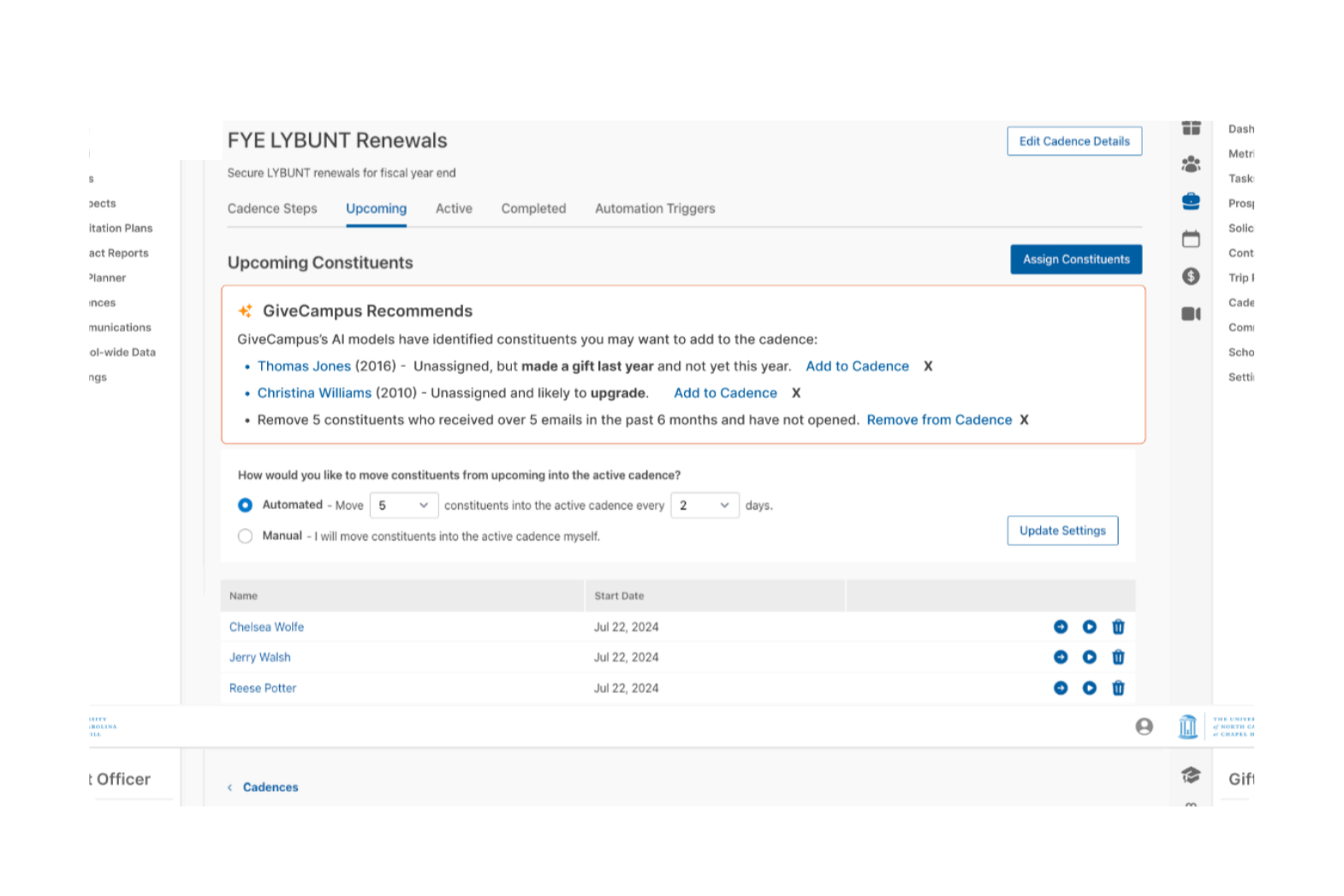
4. Act on Real-Time Engagement Signals
Here’s a scenario that happens more often than it should: a donor in your portfolio registers for a spring campus event, makes an online gift to the annual fund, or signs up to volunteer for Giving Day—and their gift officer finds out three weeks later when pulling a CRM report.
That lag is costly. The moment a donor takes an action—any action—is one of the warmest outreach opportunities you’ll have. They’re already thinking about the institution. They’ve already expressed interest. A personalized, timely message in that window lands completely differently than a follow-up that arrives weeks later with no connection to what they just did.
Because GC Gift Officer integrates fully with GC Online Giving, GC Events, and GC Volunteer Management, you get a real-time notification the moment a portfolio constituent makes a gift, registers for an event, or signs up to volunteer—and the platform prompts you to reach out while it’s still top of mind. In the last sixty days of the fiscal year, that kind of signal-to-action speed can be the difference between a conversation that closes and one that waits until July.
5. Get Your Gift Structure Conversations on the Calendar Now
Picture this: it’s June 17, a donor is ready to commit a significant stock gift, and you’ve just realized the transfer can’t settle before June 30. The gift doesn’t count this fiscal year. The donor is frustrated. So are you. This scenario plays out every year at institutions that wait too long to have the gift structure conversation—and it’s entirely preventable.
Stock transfers, Donor Advised Fund (DAF) grants, pledge agreements, and outright gifts all have lead times that are easy to underestimate when June 30 feels far away. Any gift involving a non-cash asset needs to be initiated by early June at the latest. Stock transfers can take two to three weeks to process. DAF grants, depending on the sponsoring organization, can take ten to fourteen business days. Gift agreements that require counsel review or multi-year pledge documentation need time that a last-minute conversation simply can’t create.
Go through your close-ready prospects now and ask: what’s the most likely gift structure for each of them, and what needs to happen to make that transaction possible? DAF conversations deserve particular attention. DAF gifts are, on average, 10 times larger than a credit card donation—which makes them among the highest-value asks you can have in the final sprint. And once you’ve had the conversation, DAFpay by Chariot makes the actual giving experience remarkably fast: donors can complete a DAF grant directly on a GiveCampus giving form in under 15 seconds, without navigating a separate portal or leaving the page.
Learn more about how DAFpay streamlines the process for your whole advancement team.
For gift officers building or scaling a mid-level portfolio, this William & Mary Master Class is worth a read—it covers how their team built a cadence-driven approach to exactly these kinds of donors.
For opening gift structure conversations at scale, GC Gift Officer’s AI-generated first drafts and personalized email templates do the heavy lifting—and GC Outreach lets you reach mid-level donors across email and text from the same platform, without touching your CRM. A brief, warm message that references your last conversation and flags the timing consideration is often all it takes to get a donor moving.
6. Make Every Contact Report Count—and Make Them Fast
The spring visit sprint is when contact report discipline either holds or quietly collapses. The visits are happening. The conversations are meaningful. And then three days go by, the notes are still raw voice memos or scribbled on a notepad in the Uber, and the follow-up emails haven’t been sent.
This matters more than it feels like it does in the moment. A well-documented contact report is the institutional memory that tells your leadership what’s actually happening in the pipeline, protects the donor relationship if there’s ever a transition, and sets up your next interaction with the context it needs to go somewhere. Matthew Lambert, Senior Vice President for University Advancement at William & Mary, put it plainly: “I logged 12 contact reports in GiveCampus last month. The platform turned my stream-of-consciousness thoughts into polished reports and drafted personalized email follow-ups to each donor for me. It saved me at least 2 hours.”
I logged 12 contact reports in GiveCampus last month. The platform turned my stream-of-consciousness thoughts into polished reports and drafted personalized email follow-ups to each donor for me. It saved me at least 2 hours. It was awesome.Matthew Lambert William & Mary
The free GiveCampus app, GC Contact Reports, turns raw visit notes into polished contact reports, personalized follow-up emails, and task lists in seconds. Speak your notes into your phone on the way to the airport, and you board your flight you have a complete contact report and a draft follow-up ready to review and send. You can download GC Contact Reports for iOS now. Not on iPhone? Android is coming soon—join the waitlist today.
For teams already on GC Gift Officer, the same capability is integrated directly into the platform, with follow-up emails auto-drafted from the contact report so the whole post-visit workflow happens in one place.
7. Brief Your CAO Before They Ask
In the final two months of the fiscal year, leadership is watching the pipeline closely. Board communications are being drafted. Revenue projections are being refined. And if your CDO or CAO doesn’t have a clear picture of where your portfolio stands, they’ll find one—usually at the least convenient moment, in the form of a question you have to answer on the fly.
Getting ahead of this does more than protect you—it changes what’s possible. A proactive pipeline update that covers what’s close-ready, what gift structures are in play, and what you need from leadership to close the hardest asks opens doors that a reactive update never will. Sometimes closing a gift requires the president to make a call. Sometimes it requires a leadership visit or a board introduction. None of that gets mobilized unless your CAO knows the ask is ready and what it needs.
GC Gift Officer’s Manager Dashboard gives leadership real-time visibility into pipeline status, projected close amounts, and gift officer activity—so staying aligned doesn’t require you to build a deck or schedule a standing update. The data is already there, organized in a way that tells the story your CDO needs to tell upward. Explore GC Gift Officer.
One More Thing Before You Close the Year
The fiscal year-end sprint is exhausting, and it’s easy to treat June 30 as a finish line. The gift officers who enter July with the most momentum used the final sprint to do more than close gifts—they used it to build the foundation for the year ahead.
Every conversation you have in the next sixty days is data. Every donor who engaged but didn’t close is a warm prospect for Q1. Every contact report you log is context for your next visit. Every relationship you steward well through the close—regardless of whether the gift came in this fiscal year—is an asset that compounds.
Close the year strong. And make sure you’ve set yourself up to start the next one the same way.
GiveCampus helps frontline fundraisers build more pipeline, book more visits, and close more gifts—with tools purpose-built for the way advancement teams actually work. See GC Gift Officer in action