Master Class: How Bucknell Turned Its Athletics Giving Day Into a $2.27 Million Team Effort
Oct 2026 - READ IN 8 MINUTES

Bucknell’s advancement team has spent a decade learning exactly who its athletics donors are: varsity and club athletes, proud parents, alumni loyal to a specific coach or a team, and donors who fall outside the alumni community entirely, like season ticket holders with no Bucknell degree and the aunts, uncles, and family friends in a student-athlete’s network.
That knowledge is built into every part of One Herd One Day—the school’s annual athletics giving day—which includes a generous gift-counting window, deeply personalized emails, leaderboards built for people who like to compete, and much more. The result: a decade-long climb from a clunky, varsity-only fundraiser to a more inclusive $2.27 million athletics giving day with fans across the entire university community—and across the country.
About Bucknell
Bucknell is a four-year liberal arts university in Lewisburg, Pennsylvania, with roughly 3,900 undergraduates. Its 750-plus Division I student-athletes compete across 27 varsity teams in the Patriot League, a mid-major conference far removed from Power Conference programs like the SEC or Big Ten, with their multimillion-dollar television contracts and headline-grabbing name, image, and likeness (NIL) deals.
“We are a Division I school, but we don’t have revenue-generating programs,” said Natosha Walter, Bucknell’s Associate Director of Annual Giving Marketing, Strategy & Outreach. “Our team’s success is completely dependent on gifts. We’re not a Penn State. We don’t have a football program that’s generating money.”
We are a Division I school, but we don’t have revenue-generating programs. Our team’s success is completely dependent on gifts.Natosha Walter Bucknell University
Walter has been at Bucknell for 11 years and runs the university’s giving day program—building the campaigns, maintaining the giving forms, and writing every email that goes out—with help from a small central advancement team of seven.
How One Herd One Day found its footing
Bucknell’s first giving day, the Trustee Challenge, was a university-wide effort that launched in 2013 and was eventually discontinued. But it taught the team something valuable: athletics donors thrived on the energy of a giving day. That insight led to Bison March for Excellence in 2016, the university’s first athletics-only giving day. Bison March was an internal-only effort built with an outside partner, running on a manually updated website, and open to varsity athletics alone.
It worked well enough to keep going, but it wasn’t built to scale. In 2019, the team rebranded it as One Herd One Day, opened it up to club sports, and moved the whole program onto the GiveCampus platform. That first Bison March for Excellence raised $449,676 from 1,987 donors in 2016. A decade later, One Herd One Day raised $2.27 million from 4,138 donors—and the strategy behind that growth is the subject of this Master Class.
Inside Bucknell’s playbook
Bucknell’s athletics-only giving day runs on a handful of deliberate, sometimes unconventional strategies. Each year, the team sharpens its approach based on what it learned the previous year. Here are seven winning plays you can make your own:
1. Stretch the 24-hour window without breaking it
According to Walter, the first thing to know about Bucknell’s giving day is that “it’s truly NOT a 24-hour challenge.” Spoiler alert: the team has been quietly stretching that one-day window across multiple weeks for years.
To account for offline donations, gift counting at Bucknell begins well before the campaign’s public start time. Any gift made between March 1 and the challenge’s final day—a window of typically three to four weeks—counts toward the day’s total, so checks, donor-advised funds, and wire transfers get uploaded as they come in.
A dedicated pre-launch page then opens just one day before the public 24-hour window, giving donors who want to make an online gift through the campaign page a chance to start early. By the time the campaign officially kicks off, Bucknell has typically already banked a sizeable sum—nearly $142,000 ahead of this year’s giving day.
The same logic applies at the finish line. The challenge is advertised as ending at 10 a.m., gets extended to 1 p.m. publicly, and stays open until 2 p.m. That extra window gives the team time to announce last-minute matches and catch stragglers, and it typically raises an additional $100,000 or more.
2. Borrow the trust your school already has
“Everyone has a Todd Newcomb,” Walter said. “That alum who never left. The one who bleeds blue and orange. Use them.” Todd Newcomb is the Director of the university’s Bison Club. The team built a GC Video inviting repeat donors (those who gave five or more years in a row) to become advocates, gave Newcomb a personal advocate link to solicit gifts directly, and put his name on relevant emails. It brought in 96 donors and more than $57,000.
Everyone has a Todd Newcomb. That alum who never left. The one who bleeds blue and orange. Use them.Natosha Walter Bucknell University
The same principle extends to coaches. Bucknell’s first email of the day is always signed by a coach, because coach-signed emails consistently outperform institutional emails. This year a dedicated “Honor a Coach” email brought in 62 donors on its own. Because the “in honor of” field was visible as an option on the giving form more broadly, plenty of other donors who received different emails—and never saw the Honor a Coach email at all—used that same field to name a coach when they gave. The lesson came with a cost, too: the team offered to manually process every “in honor of” gift themselves that year, and it overwhelmed them. Next time, they’re planning to add a custom tab to the campaign page and manually update it with “in honor of” and “in memory of” names throughout the day.


3. Recruit donors beyond the alumni list
Some of Bucknell’s most promising prospects were already sitting in the CRM, just not flagged as fundraising targets. Season ticket holders who show up to buy basketball tickets but never graduated from Bucknell—local fans with no degree, no reunion invite, nothing pulling them toward a typical solicitation—turned out to be a real source of new donors once the team started reaching out to them directly.
Student-athletes’ extended networks work the same way. Aunts, uncles, family friends, former coaches: most will only give once or twice, but the pool renews itself every year as rosters turn over. “It’s cyclical,” Walter said. “My aunt gives this year, and then your aunt gives next year. There’s a lot of people who participate that you don’t expect, and it’s a really fun way to engage new people.”
4. Personalize until it hurts (in a good way)
The “Honor Your Athlete” email (shown above) personalizes every element to the individual donor and brought in 101 donors—8.8 percent of the audience it reached. Landing pages are tiered by sport, so a football donor lands on the football page with the designation pre-filled and that program’s specific goal in view, while club sports share a single tier. Both tactics work because each one reads like a personal ask to a single donor. Both also take real time to build by hand, testing and all—time the team considers well spent.
Tiering also solves a scale problem unique to smaller athletic departments. A single leaderboard pitting Bucknell’s 100-plus-player football roster against its eight-person tennis team was never going to be a fair fight, and the team doesn’t have a donor willing to bankroll a program-versus-program bet like that. “It’s hard to pit them against each other,” Walter said. “We don’t necessarily have a donor that’s willing to say, ‘I’ll give to whoever wins between football and track and field.’ We don’t have that.” Splitting the competition by sport gives every team, regardless of size, its own campaign to win—an advantage Walter says could work especially well for smaller athletic departments.
5. Give every student-athlete a job—and a link already in hand
For years, getting student-athletes to advocate meant asking them to create a GiveCampus account first, a small step that hampered participation. This year, Bucknell’s athletics staff supplied emails for every student-athlete, the team uploaded them directly into its advocacy tool to generate personal links automatically, and two reminder emails went out through GC Outreach with those links built in. Advocacy-attributed gifts jumped from 945 last year to more than 1,500 this year, a 60 percent increase all from removing a single point of friction.
6. Set a bar every player has to clear
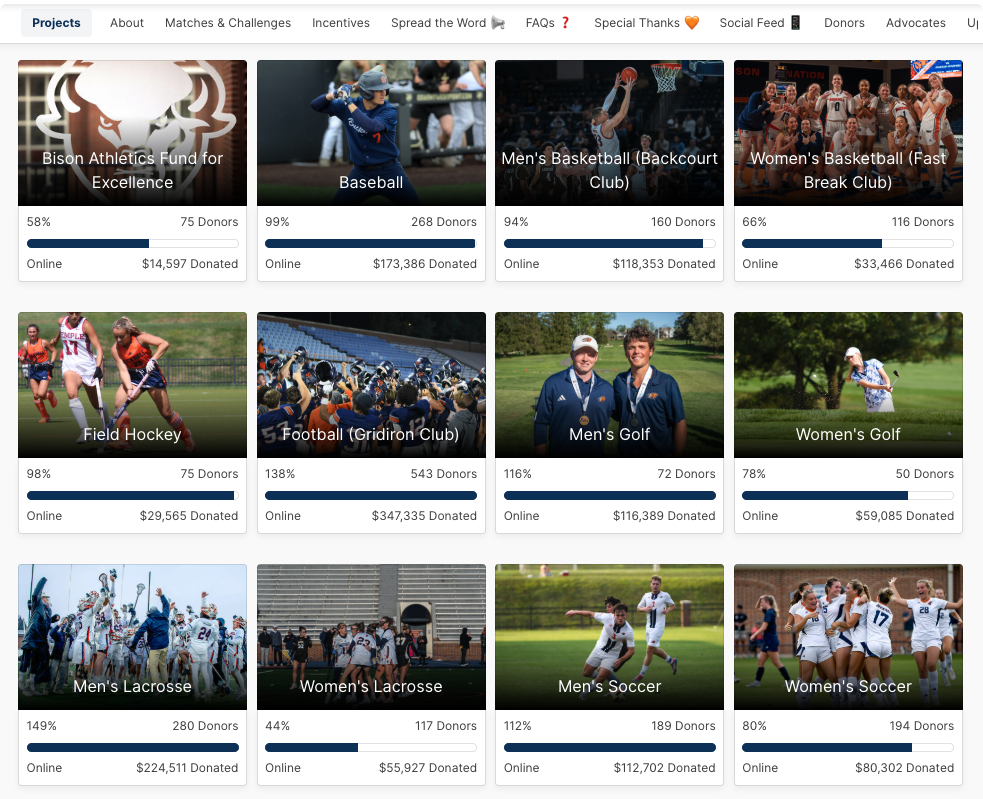
One coach took that advocacy push further than the team expected. A new, high-energy football coach told every player on the roster they were personally responsible for generating at least five gifts. The results: 222 donors and $179,696 the year before, and 543 donors and $347,335 once Coach Jeff got involved—nearly double the donors and gifts, from one coach’s expectation-setting. He later invited Bucknell’s advancement team to a practice, to meet the team and see firsthand how much their work mattered to the program.
7. Make it a competition
Athletes and their families respond to a challenge, so Bucknell builds several into their athletics giving day. Students and staff who generate 10 or more gifts earn a trucker hat (38 claimed this year). Custom leaderboards keep coaches checking in—”coaches take these very seriously,” Walter said—and a state map highlights where the team still needs donors to show up. Working with gift officers, the team also coordinated 86 matches and challenges that together raised $1,020,000. Walter cautioned that balancing that many incentives across 27 teams comes with substantial coordination overhead, and not every coach loves the pressure a challenge creates.


Underneath all of it, Bucknell tracks relentlessly—more than eight pages of unique URLs—and retires any tactic that underperforms after a few tries. Every donor also gets a thank-you video within an hour of giving, split by varsity, club, and crew, so the follow-through feels as personal as the ask.
See the growth by the numbers
Ten years of testing, tweaking, and repeating what works netted numbers like these:
- 4,138 donors, $2.27 million raised—One Herd One Day 2026
- 96 donors, $57,000+ from a single alumni-ambassador video and personal advocate link
- 62 donors from the “Honor a Coach” email
- 101 donors from “Honor Your Athlete,” 8.8 percent of the audience it reached
- 543 donors from the football team alone after one coach’s advocacy push set a five-gift expectation
- 1,500 advocacy-attributed gifts, a 60 percent year-over-year jump, after removing the account-creation step for student-athletes
- 86 matches and challenges, $1,020,000 raised
- $100,000+ raised in the hour or two after the “official” deadline


How peer schools can apply this
- Decide how generously you’ll count a gift before the day starts. A pre-launch page and a process for uploading offline gifts capture donors a strict 24-hour window would otherwise miss.
- Find your school’s Todd Newcomb. Every campus has a beloved, long-tenured figure donors already trust—give them a video and a personal link to solicit gifts directly.
- Have coaches sign emails under their own name. A coach’s name in the “from” field consistently outperforms other senders.
- Look for donors outside your alumni list. Season ticket holders and student-athletes’ extended families are often already in your CRM, just not flagged as prospects.
- Remove the smallest points of friction for student-athlete advocates. Pre-built links beat asking them to create an account first.
- Build in real competition—leaderboards, incentives, matches—but plan for the coordination it takes to run across every team and gift officer involved.
- Track everything, and be willing to kill a tactic that isn’t earning its keep. Bucknell monitors more than eight pages of unique URLs and retires any tactic that underperforms after a few tries.
Key takeaways
Bucknell’s $2.27 million is the product of a decade of small, deliberate adjustments: a more generous gift-counting window, borrowed trust from familiar faces, a donor pool that reaches beyond the alumni list, personalization built by hand, and a student-athlete advocacy process with the friction removed. Any school can build on the same approach—treating a giving day as a system worth editing every year, year after year.
Apply this approach to your own athletics giving day
Bucknell’s approach shows what’s possible when personalization, advocacy, and a little friendly competition come together around athletics donors. See how the GiveCampus platform helps athletics fundraisers engage more donors with targeted sport-specific giving forms, nimble campaigns around rivalry games, support for booster memberships, and more.
This Master Class is based on a popular GCPC’26 session presented by Natosha Walter—popular enough that we invited her back for our live Genius in the Room series. Watch now to hear firsthand how Natosha’s team at Bucknell approaches athletics fundraising.
Frequently asked questions
What is Bucknell’s One Herd One Day?
One Herd One Day is Bucknell University’s annual athletics giving day, open to both varsity and club sports. It grew out of Bison March for Excellence, a varsity-only fundraiser the team launched in 2016, and moved onto the GiveCampus platform in 2019.
How much has Bucknell raised through its athletics giving day?
One Herd One Day raised $2.27 million from 4,138 donors this year, up from $449,676 from 1,987 donors in the program’s first year, 2016.
How long does One Herd One Day run?
The campaign publicly runs for 24 hours, but gift counting actually opens on March 1, typically three to four weeks before launch, and stays open through the challenge’s final day.
How does Bucknell get student-athletes to advocate for the campaign?
Bucknell’s athletics staff supply an email for every student-athlete, which the advancement team uploads directly into its advocacy tool to generate personal fundraising links. Two reminder emails go out through GC Outreach with those links included, removing the step of asking students to create an account first.