The Recurring Giving Playbook: How to Segment Smarter, Ask Better, and Build Lasting Revenue
Aug 2026 - READ IN 16 MINUTES

The expected lifetime value (LTV) of an indefinite recurring donor is nearly 10 times that of a one-time donor. That figure holds across every type of school on the GiveCampus platform—large and small, public and private, higher education and independent schools—and it’s the reason recurring giving deserves a dedicated program, with clear goals and a strategy behind it.
Given the persistent “dollars up, donors down” trend reported by Giving USA and others, maximizing the LTV of each donor relationship matters more than ever. This guide starts with the fundamentals in Recurring Giving 101, then turns to strategy: five things that determine whether a program becomes a real recurring revenue engine—who to ask, how to ask, when to ask, why it’s worth the investment, and how to keep gifts active once they’re set up. This playbook covers all five.
Recurring Giving 101
Before segmentation, ask strategy, or campaign timing, it helps to have a shared vocabulary: what is recurring giving, how do the options work on a giving form, and what makes an indefinite recurring gift different from a fixed-term one.
What does a high-performing recurring giving program look like?
Eighty-five percent of GiveCampus Partner schools have recurring giving turned on—and the revenue data shows what happens when schools actively build a program around it.
Partner schools report anywhere from $50 to several hundreds of thousands in annual recurring revenue, with an average of $17,401. That disparity in range is the difference between enabling recurring giving as an option on a form and actively building targeted campaigns around it.
Schools at the high end have made recurring giving a deliberate part of their fundraising playbook—with clear acquisition goals, smart segmentation, and proven retention strategies.
Only one percent of donors set up a recurring gift without prompting. Still—across a 100,000-person constituent file—that’s 1,000 high-value relationships just waiting to be activated, making recurring giving a smart option to have on the table even if you’re just getting started.
Predictive modeling can help you identify those donors who are most likely to say yes to a recurring giving ask. GiveCampus data shows 15.9 percent of donors flagged as likely to give recursively go on to do exactly that, compared to 0.1 percent of unflagged donors—140 times greater precision than a broad outreach list.
How recurring giving options work
To a donor, recurring giving looks simple: choose an amount, pick a recurring option, and complete the gift. That simplicity is the result of decisions your team makes long before the form goes live.
At its core, recurring giving lets a donor make an ongoing commitment instead of a one-time donation. They can give monthly, annually, or on another schedule your institution makes available. Depending on how the form is configured, that commitment can run until the donor cancels, continue for a set number of payments, or end on a specific date.
Your team decides how much of that choice to put in front of the donor. Some campaigns are better served by a simple experience: a monthly gift that continues until canceled. Others call for more flexibility, letting donors pick their own frequency or end date. Neither approach is inherently better—the right setup depends on the campaign’s purpose and the behavior you want to encourage.
Be intentional about it. Defaults shape how a donor understands the ask, how much effort the decision takes, and whether recurring giving feels like a natural next step. A well-configured recurring option makes that choice easier for the donor.

What is an indefinite recurring gift—and why does it matter?
Most donors who set up a recurring gift choose the open-ended path: 62 percent of recurring gifts on GiveCampus are monthly rather than annual, and a large share of those carry no end date at all.
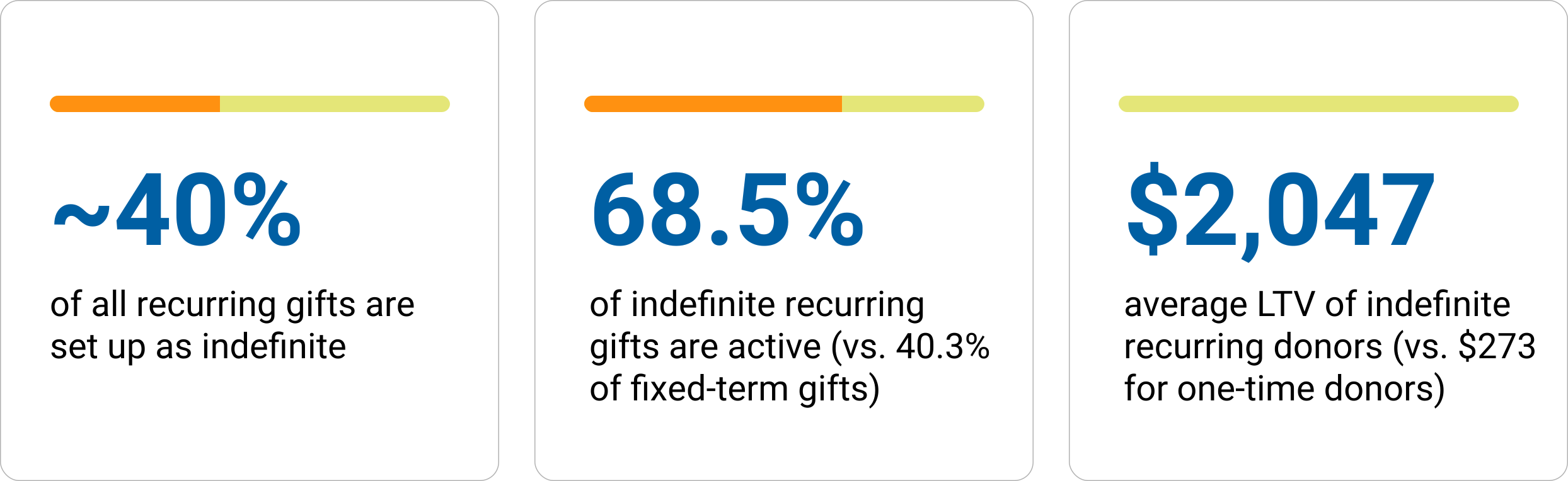
Indefinite recurring donors—those with no end date on their gift—are on pace to contribute an average of $2,047 over their giving lifetime, compared to $273 for a one-time donor.
Indefinite donors also simply stick around longer. On the GiveCampus platform, indefinite recurring gifts maintain a markedly higher active rate than fixed-term recurring gifts—68.5 percent versus 40.3 percent—because there’s no built-in expiration prompting a donor to reconsider.
About 40 percent of all recurring gifts on GiveCampus are set up as indefinite, making them the highest-value segment of any recurring program. They’re also the most underrepresented in campaign reporting. Because an indefinite gift has no end date, only its first installment counts toward a campaign total; subsequent installments accrue outside the campaign window. The donor’s true value to your institution is much larger than what any single campaign reflects—which is why recurring acquisition rewards a longer measurement horizon than a Giving Day result or a fiscal year close.
Four populations require four strategies
Most advancement teams treat recurring giving as one conversation. A well-built program treats it as four, each with its own goal, its own ask, and its own measure of success.
1. Recurring acquisition
These are the donors with no active recurring gift—and statistically, the easiest to convert if you find the right ones. Gift size points toward those donors at the lower end of the range: GiveCampus data shows donors averaging $0–$1,000 per gift convert to recurring giving at four times the rate of higher-average-gift donors (0.4 percent vs. 0.1 percent). That tracks with how the subscription economy works everywhere else: spreading a commitment into smaller, recurring installments fits a budget more easily than a single larger gift, whatever a donor’s overall capacity.
2. Recurring upgrade
These donors are already committed—they set up a recurring gift at some point and have kept it going, which means they believe in your institution enough to give on a schedule. The goal here is a modest amount increase, framed well. How to frame it is covered in the “Ask arrays and giving outcomes” section below.
3. Leadership upgrade
These are one-time or occasional donors with wealth and engagement signals pointing to higher capacity. Donors flagged by the GiveCampus upgrade model gave $500 or more at 9.3 times the rate of unflagged donors, and donors aged 60 to 70 show the highest upgrade propensity on the platform, at 1.0 to 1.2 percent. This group is worth a targeted outreach approach alongside the giving form.
4. LYBUNT re-engagement
These are last year’s donors who haven’t yet renewed. The right ask for them is simply to renew—at the level they gave before. Upgrading comes later. Smart Ask Amounts reduced downgrade rates for LYBUNTs from 24.5 percent with a generic array to 11 percent, because showing these donors an amount that reflects their previous giving signals that you know them and expect them to stay. A LYBUNT who renews at the same level is far more likely to upgrade in the year that follows.
Sorting donors into these four groups is the harder half of the work. GC Intelligence and Smart Segments handle that identification automatically. Smart Segments are AI-generated predictive lists that score each constituent on their likelihood to take a specific action—including setting up a recurring gift. The model updates as new giving data comes in, so your lists stay current rather than reflecting a snapshot from your last data export.
Applied to a recurring giving campaign, a Smart Segment gives your team a pre-qualified audience for outreach or a targeted appeal, with Smart Ask Amounts calibrated for each person in it. Smart Ask Amounts delivered through a Smart Segment are 15 percent more likely to be accepted than generic asks.
Ask arrays and giving outcomes
Ask amounts shape how donors interpret what’s expected of them. When those amounts are misaligned with a donor’s actual giving history, the result is often an unintentional downgrade: the form makes it easy to give less without the donor meaning to.
GiveCampus Smart Ask Amounts data from the first half of fiscal year 2026 makes the difference concrete. Compared to donors shown a generic array or no suggested amounts at all, donors shown a Smart Ask array were up to 8 percent more likely to upgrade, 54 to 58 percent less likely to downgrade, and 21 to 28 percent more likely to match or exceed their largest prior online gift.
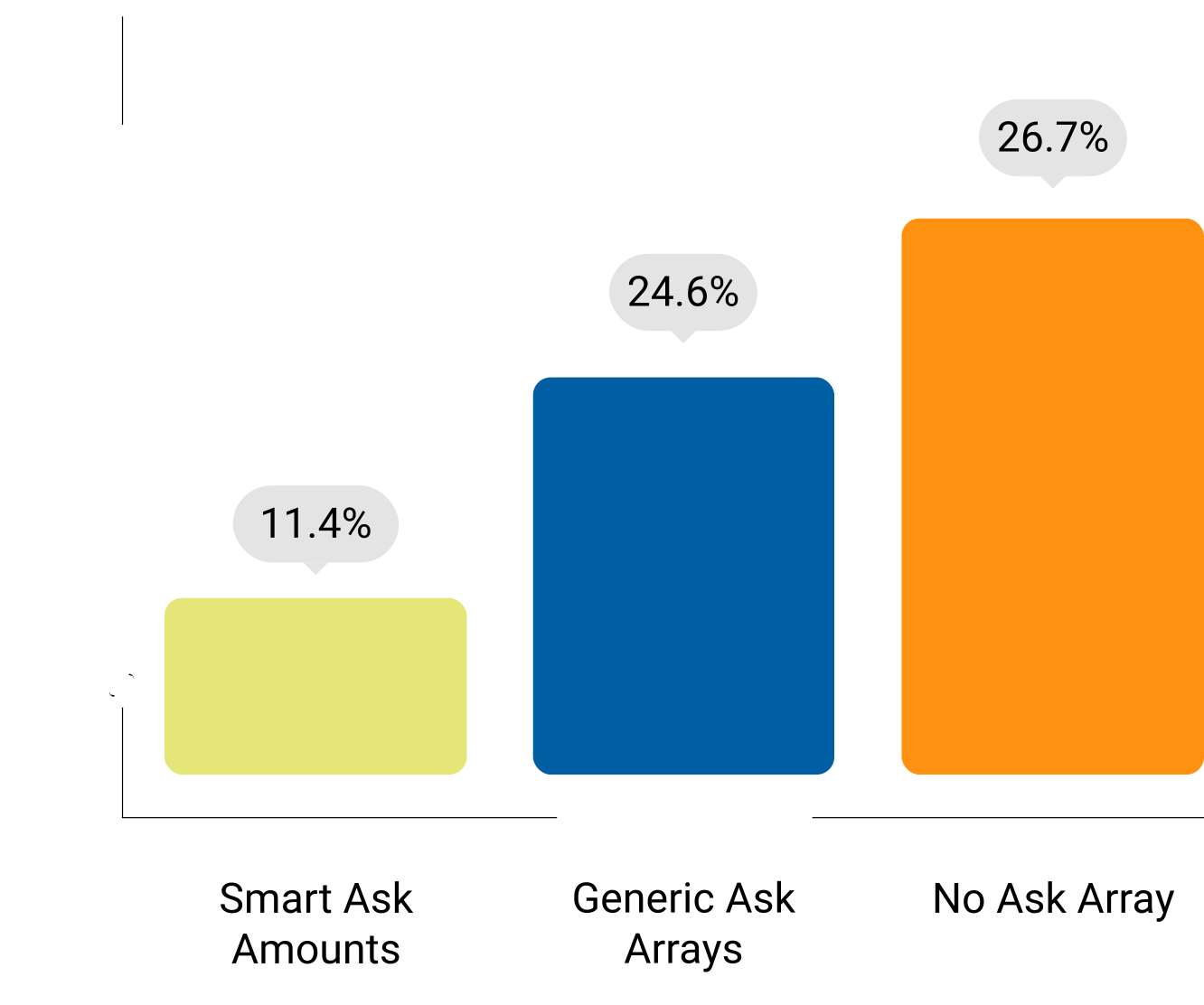
Isolated by condition, downgrade rates tell the same story: 11.4 percent for Smart Ask donors, 24.6 percent for those shown a generic array, and 26.7 percent for donors shown no array at all.
The effect gets stronger when donors actually engage with the suggested amounts. A donor who accepts a Smart Ask Amount upgrades 33 percent more often and downgrades 90 percent less often than a donor who rejects the suggestion, and makes a gift 16 percent larger on average than if they’d chosen the nearest option on a generic array.
For recurring programs, the three posture settings in Smart Ask Amounts align directly with the four populations above. Conservative or neutral works best for LYBUNT re-engagement, where the goal is renewal before growth. Aggressive is right for recurring upgrade and leadership upgrade audiences, where the data says there’s room to move.
That baseline comparison—Smart Ask arrays against generic ones—played out directly at Westminster School. During a recent Giving Day, the school put Smart Ask arrays on some forms and generic arrays on others, and the results were clear: 79 percent of donors shown a Smart Ask array accepted the suggested amount, compared to 44 percent shown a generic array. The median gift was $100 for Smart Ask donors vs. $50 for the generic group, and 47 percent of Smart Ask donors upgraded from their previous online contribution—generating $6,233 in additional revenue—compared to 34 percent in the generic group.
Katherine B. Malchoff, Director of Annual Giving at Westminster School, described the outcome, “During our recent Giving Day, nearly half of the donors who received Smart Ask Amounts on their giving form gave more than they did the year prior. Smart Ask Amounts played a huge role in the success of our event, and I will definitely use them again!”
On our Giving Day, nearly half of donors who received Smart Ask Amounts gave more than they did last year. Smart Ask Amounts played a huge role in our success, and I will definitely use them again.Katherine Malchoff Westminster School
Download the Smart Ask Amounts white paper for a deeper look at the data behind personalized ask arrays.
Campaign moments for recurring acquisition
Certain moments in the fundraising calendar are reliably high-intent for recurring giving. Each one calls for a different approach.
Year-end campaigns
June and December are the highest-conversion months for recurring gift setup on the GiveCampus platform, but they work differently.
December is donor-driven. The holiday giving season, combined with the calendar year-end tax deadline, puts donors in a natural giving mindset. Many are actively looking for meaningful commitments to make before December 31, which makes a recurring gift feel like a timely and purposeful decision rather than an ask that could wait.
June requires more intention. Fiscal year end on June 30 is meaningful to your team—it’s the date you’re closing the books and measuring progress toward goals—but most donors don’t know when your fiscal year ends or what it means for them.
That urgency is institutional, and it has to be built deliberately. Schools that see strong June recurring acquisition are the ones actively creating it: communicating the deadline, explaining what it means, and giving donors a concrete reason to act before the month closes.
In both cases, a first-time recurring commitment feels like a natural extension of the moment. Embedding the recurring toggle on the prepayment form—where donors are already making decisions about amount and designation—puts the option in front of them at exactly the right moment. For a deeper look at optimizing giving forms for conversion, see Smarter Forms, Larger Gifts: How Personalization and AI Can Supercharge Your Giving Form.
Giving day campaigns
Most Giving Day matches and challenges are structured around single-day totals—which means the incentive optimizes for that day and little else. Reorienting the structure around recurring commitments changes the calculus entirely.
A recurring-focused match credits match dollars each time a qualifying gift is successfully processed—monthly or annually—rather than just on the day of the campaign. The incentive reinforces the habit of giving over time rather than rewarding a single transaction.
A recurring-focused challenge works differently: it releases a sponsor’s dollars only when the campaign hits a recurring-specific milestone, such as a target number of new recurring donors or a dollar threshold in recurring gift revenue. That means the campaign “win” is measured in sustainable commitments—the kind of result that keeps contributing to your revenue stream long after the day ends.
Tighter segmentation sharpens both approaches. Layering recurring-only logic with filters by affiliation, class year, designation, or gift minimum means the incentive is aimed at exactly the audiences and behaviors that build retention and lifetime value.
The result is a campaign structure that functions as a behavior-change engine. A donor who starts a recurring gift during a Giving Day stays a recurring donor for months afterward, and the long-term value of that relationship compresses the acquisition cost into something very small.
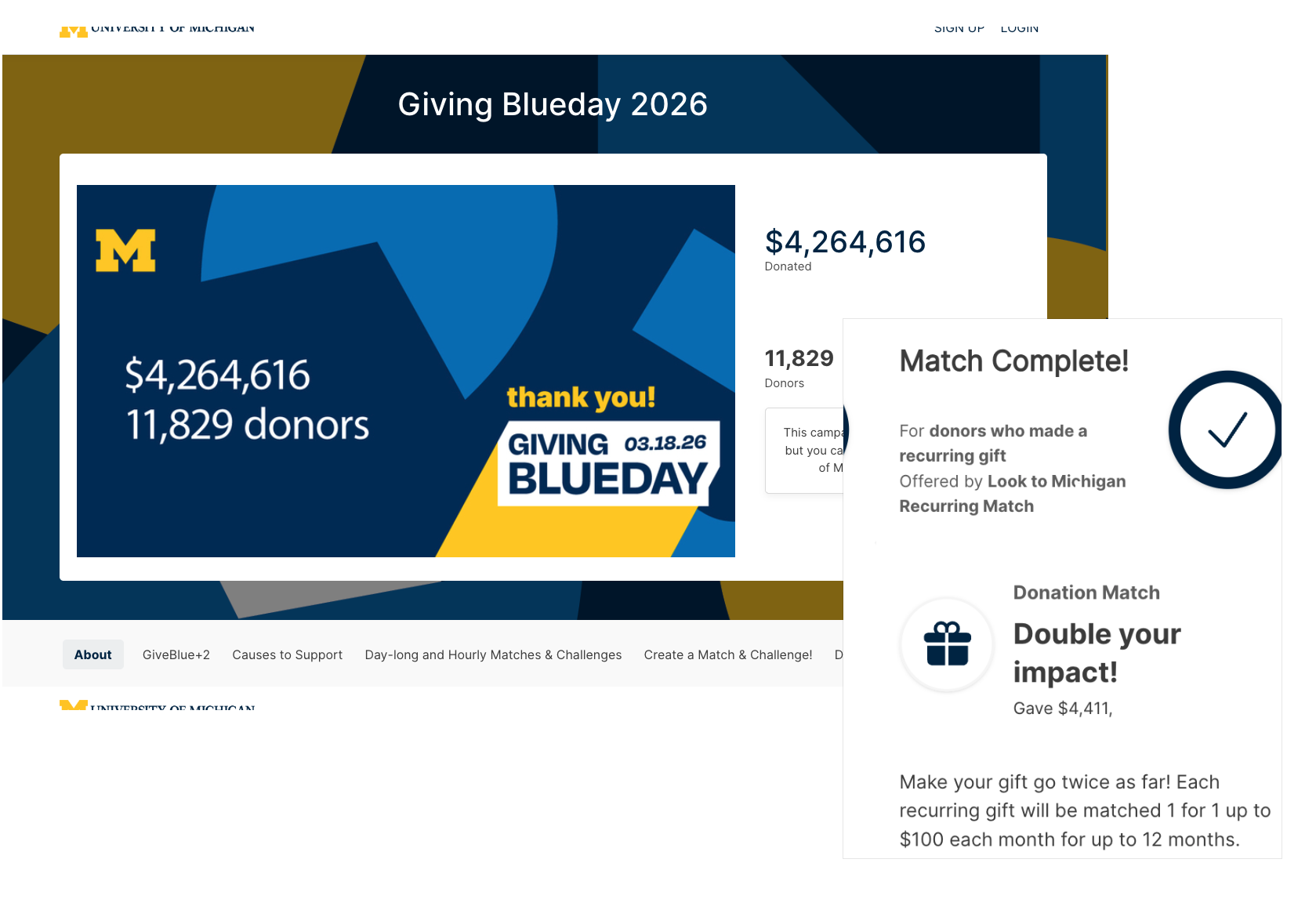
The University of Michigan built exactly this kind of match. Facing fewer than 300 monthly gift setups in fiscal year 2025 and a giving experience the team knew wasn’t pulling its weight, they simplified how donors set up a recurring gift and launched a Look to Michigan match: every new monthly donor is matched dollar-for-dollar, up to $100 a month, for a full year.
On Giving Blueday alone, the match drove more than 100 new recurring gift setups. Across the full fiscal year, monthly gift setups climbed to 1,400—roughly a 400 percent year-over-year increase—and the university renewed the match for the following year. A match tied to recurring behavior gives donors a reason to commit that a single day of matching can’t.
Events
Events work the same way. Thirteen percent of GiveCampus event registrants make a gift at checkout. For schools that include a recurring toggle on the event giving module, that moment of high intent and strong institutional connection is one more place the conversation can begin.
Senior gift campaigns
Senior gift campaigns are already built around asking a graduating class for one meaningful, collective gift—a natural launchpad for a recurring giving community with staying power beyond graduation day.
Noble and Greenough School offers one of the most detailed young-donor examples on the platform. The team created The Dawg Pack—a recurring giving community named after the school’s mascot, with a minimum three-year commitment and branded membership incentives for joining. In their first year, 26 of 121 graduating seniors enrolled: more than 20 percent of the class, up four percentage points year over year.
Sara DiCenso, Annual Giving Coordinator at Noble and Greenough, put the strategy simply: “We’re hoping to create a baseline group with The Dawg Pack so as we do our individual asks throughout the year our participation rates can only go up.”


The approach centered on culture: building the habit of giving before seniors ever left campus. A student who makes their first philanthropic commitment at 17 or 18, under a name they recognize and a brand they feel proud to be part of, starts to think of themselves as a donor.
That identity is what carries forward into a lifetime of support—and it’s why the school has made The Dawg Pack a permanent part of every senior gift campaign since.
How recurring giving compounds
Recurring giving’s strongest argument is a long-term one. For indefinite recurring donors, the compounding effect extends well beyond three years. But even using three years as a conservative measurement window, the data is striking.
GiveCampus data shows a consistent pattern: donors who retain their giving level today generate 58 percent more revenue over the next three years than donors who downgrade. Donors who upgrade today generate twice the revenue of downgraders over the same period. Short-term giving behavior, then, is a reliable indicator of long-term value—and the decisions your forms and ask strategy make today are shaping what your file looks like three years from now.
Some of that compounding happens where no one’s watching. July and August are typically the quietest months on the fundraising calendar, but recurring installments don’t take the summer off: in a typical year, they can account for up to 13 percent of total platform giving on GiveCampus, running quietly in the background while your team’s attention is elsewhere.
Extend that horizon further, and the argument gets even stronger. A recurring donor has already opted into an ongoing relationship with your institution, without you having to ask them to renew it. The typical major or estate gift is preceded by seven-plus years of consistent giving, and a recurring donor is already living inside that pattern. Stewarding that relationship well is what makes an eventual upgrade conversation feel like a natural next step.
That instinct—treat an ongoing commitment as something to keep reinforcing—is exactly what’s driving the loyalty economy everywhere else. Ninety percent of companies now run some kind of loyalty program, and 46 percent of consumers age 25 to 44 subscribe to at least one subscription service—precisely the age range advancement teams struggle most to engage. Recurring giving meets them in a format they already trust.
That trust shows up in the numbers wherever it’s measured. Havas’s Meaningful Brands research has tracked brands consumers rate as genuinely meaningful outperforming the stock market by 222 percent since 2013.
For higher education, the same pattern holds at the level of the individual donor relationship. The National Alumni Survey’s 2026 Annual Report found that alumni who feel their personal interests are known “extremely well” by their alma mater average $481,228 in lifetime giving, compared to just $8,092 among those who feel not known at all. Alumni who feel their philanthropic priorities are understood show a similar gap: $500,774 versus $3,732.
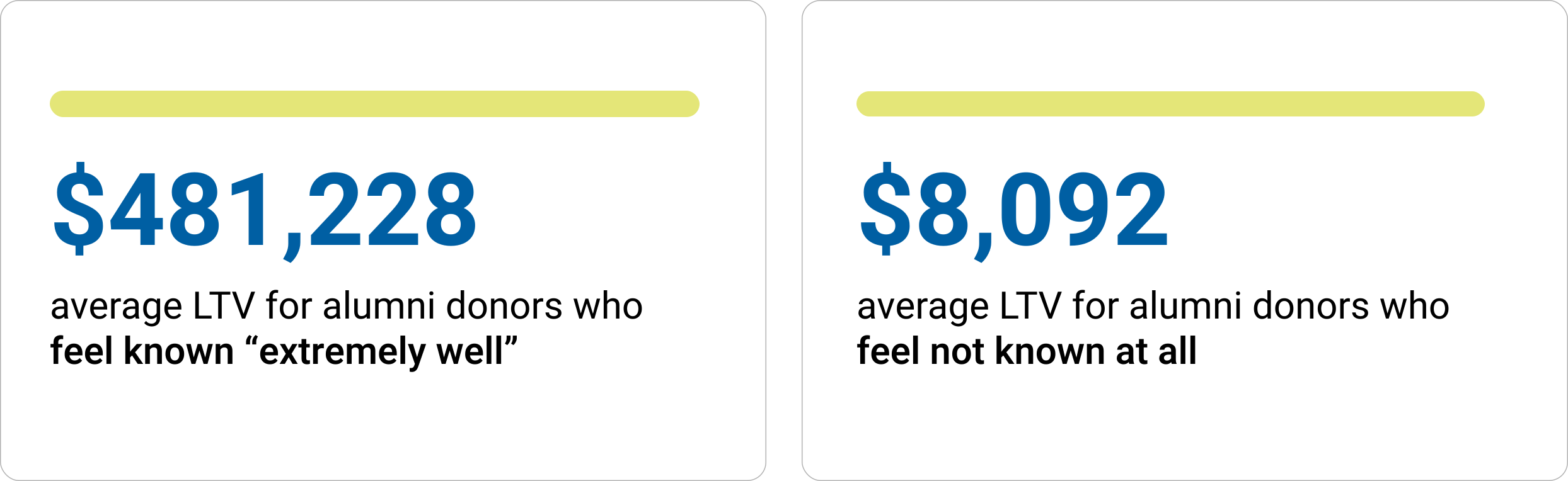
Howard Heevner, the survey’s co-founder, points to this as one of the strongest predictors of lifetime giving in the entire dataset—well ahead of most of what advancement teams spend their time optimizing. Retention is a relevance problem. An indefinite recurring gift is one of the clearest signals a donor can send that they’re ready to be known—which makes protecting that relationship, once it’s set up, worth just as much attention as winning it in the first place.
An indefinite recurring donor generates significantly more over three years than a one-time $300 donor, and the gap widens with each passing year. Modeled across 1,000 indefinite recurring donors giving $100 per year, using the 10x lifetime value figure, the three-year projection is the kind of number worth putting in front of your leadership team.
Keeping recurring gifts active
Recurring giving maintains itself only if you’ve put the right infrastructure in place. Many teams don’t set it up until they’ve already lost donors they didn’t need to lose. GC Online Giving includes built-in tools for all of the following.
Auto-updater
The most common reason recurring gifts lapse is one of the most preventable: an expired card. GiveCampus automatically updates credit card details when cards expire or are reissued, with no action required from staff or donor. Across the platform, this has rescued $10 million in recurring gifts that would have quietly disappeared. It works precisely because it’s invisible.
Gift Nudges
When a gift is about to lapse—or a payment has already failed—donors hear from you before the relationship goes cold. GiveCampus Gift Nudges send automated reminders timed to each giving cycle, including immediate outreach when a payment fails, so the conversation happens right away rather than weeks later when your team catches it in a report.
Donor self-service
Donors who can manage their own recurring gift are more likely to keep it active. GiveCampus gives them a secure single-click link to update their payment method, skip an installment, or change their designation—no staff involvement required.
Before the University of San Diego (USD) adopted this model, a recurring gift change meant a staff member canceling the existing gift, manually restarting it, and sometimes asking the donor to read their credit card number over the phone. When USD migrated to GiveCampus, they reached out personally to every active recurring donor before their next payment date. Roughly 75 percent transitioned, and several upgraded their gift in the process.
This works at scale, too. When every Brigham Young University institution and campus moved onto GiveCampus, the team migrated thousands of active recurring gifts and cloned more than 160 giving forms—in two months—without asking a single donor to restart a sustaining gift from scratch.
The calculus is similar for schools evaluating a full platform switch. Luke Walsh, Assistant Director of Development at the US Air Force Academy Foundation, described what made the decision straightforward: “Once we saw the ability to transfer our recurring gifts and still offer the personalization we loved on the social fundraising side, it was a no-brainer.”
Once we saw the ability to transfer our recurring gifts and still offer the personalization we loved on the social fundraising side, [switching our giving forms to GiveCampus] was a no-brainer.Luke Walsh US Air Force Academy Foundation
Reporting
Recurring gift performance is easier to protect when you can see it clearly. GiveCampus tracks lifetime value, expected run dates, and gift status in real time, so your team can spot churn risk early and understand which acquisition channels are producing the most durable donors.
Stewardship ties it together
Recurring donors who receive differentiated recognition—their own acknowledgment series, distinct communications, a named community like Noble and Greenough’s Dawg Pack—retain at meaningfully higher rates than those folded into the general annual fund cadence. When recurring donors feel like a distinct group with distinct standing, they act like one: they stay.
The segmentation, ask strategy, and form configuration in this playbook are operational. Their payoff is measured in years, and—for GiveCampus Partner schools—your fiscal year-end report is the fastest way to check your progress against it. It shows your recurring gift counts and dollars, which GiveCampus solutions and features you’re actually using, and how your total online giving compares year over year. If you haven’t looked at that report through a recurring lens before, that’s the place to start.
Frequently asked questions
How much more is a recurring donor worth than a one-time donor?
An indefinite recurring donor—one with no set end date—is worth nearly 10 times the donor lifetime value of a comparable one-time donor on the GiveCampus platform. Platform data puts indefinite recurring donors on pace to generate $2,047 in lifetime giving, compared to $273 for a one-time gift.
How do you build a recurring giving program from scratch?
Start by deciding what recurring options your giving forms will offer—monthly, yearly, or both, and whether donors can choose an end date—then build acquisition around your highest-converting moments; June and December are typically the strongest months for setup. From there, segment your file into the four recurring populations (acquisition, upgrade, leadership upgrade, and LYBUNT re-engagement) and put donor retention infrastructure in place, like automatic card updates and donor self-service, so the gifts you win don’t quietly lapse.
How should you segment donors for a recurring giving strategy?
A well-built recurring program treats donors as four distinct donor segments: recurring acquisition, recurring upgrade, leadership upgrade, and LYBUNT re-engagement. Each population calls for a different ask, a different tone, and a different measure of success, and predictive tools like Smart Segments can identify which donors belong in each group automatically.
What’s the best recurring giving strategy for a Giving Day?
Structure the incentive around recurring behavior instead of single-day totals: a recurring-focused match credits dollars every time a qualifying gift processes, not just on the day of the campaign, and a recurring-focused challenge releases sponsor dollars only when the campaign hits a recurring-specific milestone. The University of Michigan used this approach to grow monthly giving subscriptions from fewer than 300 to 1,400 in a single fiscal year.
What is an indefinite recurring gift?
An indefinite recurring gift is a recurring donation with no fixed end date and no set number of installments—it continues until the donor cancels it. Indefinite gifts make up about 40 percent of all recurring gifts on GiveCampus and maintain a markedly higher active rate than fixed-term recurring gifts, which is why they’re the highest-value segment of any recurring giving program.
Want to see how these strategies apply to your institution? Talk to a GiveCampus fundraising expert.