Our Biggest GiveCampus Partners Conference Yet: Highlights from GCPC 2026
Aug 2026 - READ IN 6 MINUTES

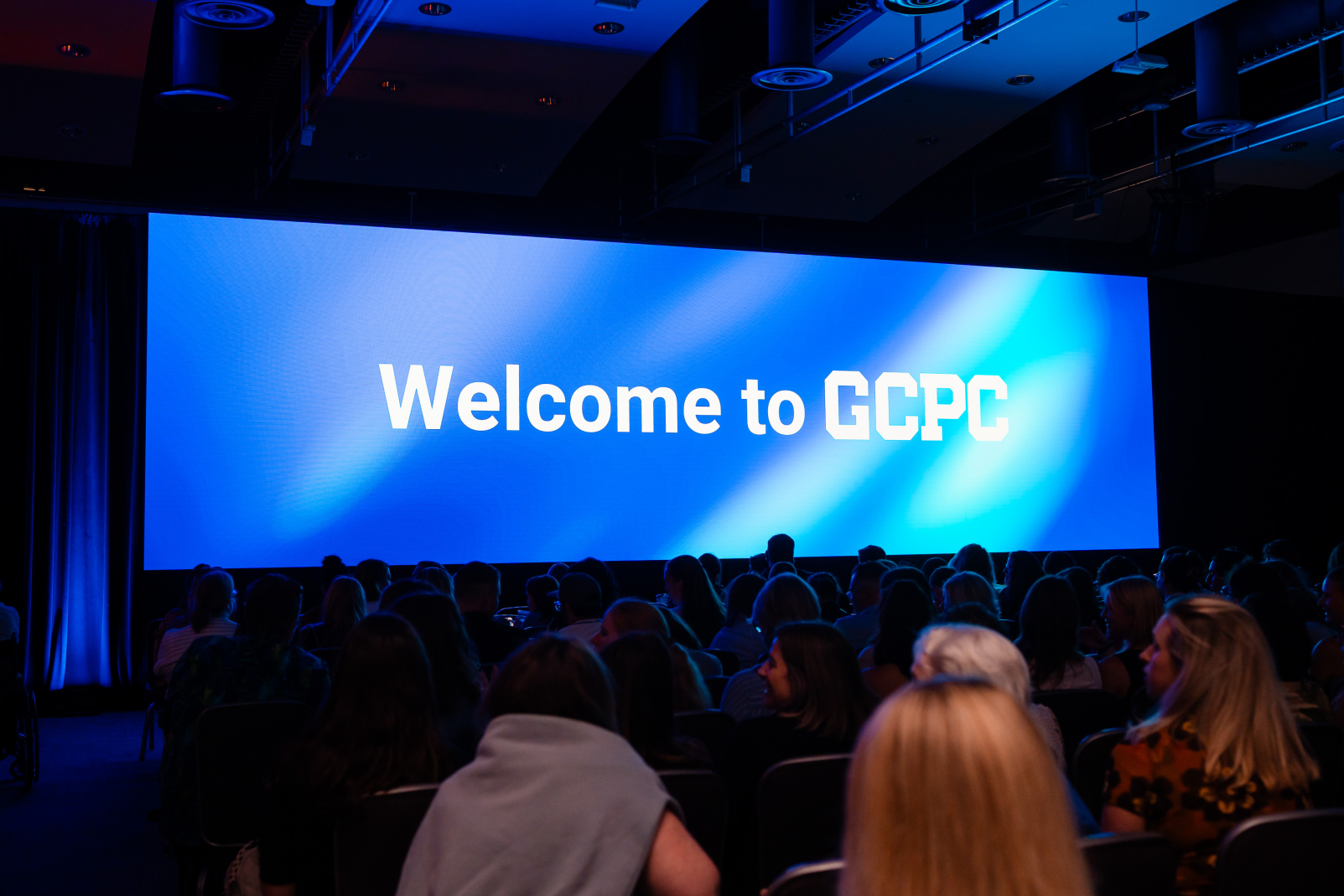
This year, the GiveCampus Partners Conference (GCPC) welcomed more advancement professionals than ever before, with more sessions and more energy to match. GCPC 2026 returned to the Ronald Reagan Building and International Trade Center in Washington, D.C.—the same venue that hosted us last year—for three days themed “Advancing Innovation.” More than 600 advancement professionals joined in person for 50+ sessions in all: three Plenary presentations, dozens of breakout sessions hosted by Partner schools, and six hands-on workshops. Thousands more tuned in to the livestream from across the country.

Many breakout rooms were standing-room only from the first round on Tuesday afternoon through the final sessions Thursday morning—a sign of just how hungry this community is to learn from one another. If you couldn’t make it (or couldn’t make it to every session you wanted), here’s a recap of the week—starting with the challenge that set the stage for everything else.
The next-gen philanthropist challenge
GiveCampus co-founder and CEO Kestrel Linder opened the Product Plenary with a number worth celebrating: donors gave $92 billion to U.S. educational institutions last year, a new record and the most given to any nonprofit sector. Then came the harder number.
Overall charitable participation in the U.S. has dropped from nearly two-thirds of households a decade ago to about half today, and donor populations at educational institutions specifically have been shrinking two to three percent every year. Of the roughly 340 million Americans alive today, 57 percent were born after 1980, and this generation is on track to inherit or create a combined $200 trillion or more in wealth over the coming decades. Yet last year, only one in 18 people born after 1980 made a gift to their alma mater.
Of the roughly 340 million Americans alive today, 57 percent were born after 1980, and this generation is on track to inherit or create a combined $200 trillion or more in wealth over the coming decades. Yet last year, only one in 18 people born after 1980 made a gift to their alma mater.Kestrel Linder GiveCampus
Engaging the next generation of philanthropists, Kestrel said, is the defining challenge of our industry. He predicted advancement professionals would help grow annual giving to education from $92 billion to $200 billion over the next decade, and GiveCampus schools are already playing an outsized role in that goal. GiveCampus is three years into a $100 million investment in the platform, and schools are already seeing the return. They raised $10 billion on the GiveCampus platform last year alone—about 11 percent of all money raised by U.S. educational institutions.
With that challenge on the table, Kestrel welcomed Head of Product Jennn Schilling to the stage for a walk through the platform’s latest capabilities.
What’s new and what’s next
GC Online Giving: more flexible, more personal
Seventy percent of donors across the GiveCampus community now give online, up 10 points from last year. As that channel becomes the default, GiveCampus is investing in giving that’s both more flexible and more personal. A new Membership Form type, currently in beta, makes it easier to manage tiered-benefit programs like alumni dues and booster clubs. GC Rivalries, launching this fall, lets schools of any size go head-to-head in fundraising challenges scored by percentage of goal. And next spring, an all-new page builder will give schools control over the layout, fonts, colors, and imagery on social fundraising campaigns and personal advocacy pages.
Design flexibility helps donors engage with a campaign, but personalization is what moves them to give. Donors are twice as likely to give when a form is personalized to them, including the ask amount. Smart Ask Amounts, which uses predictive AI to suggest gift arrays tailored to each donor, drove 23 percent higher gifts on average last year—a lift George Washington University validated with a 150,000-donor test that saw a 32 percent increase.
GC Outreach: a new no-code email editor shaped by Partner feedback
Personalization only pays off if donors actually see it, which is where GC Outreach comes in. A new no-code email editor, built with input from schools like Mizzou, DePauw, Reed, and Harpeth Hall, is now live platform-wide, giving fundraisers more control without engineering help. Before hitting send, a new Email Grader inside GC Intelligence scores each draft and flags what to improve: emails rated “excellent” earn five times the click rate of those rated “low.”
GC Events: built for everything on the calendar
Reaching donors by email and text is one thing; bringing them together in person is another. GC Events hosted 15,000 events last year, including Howard University’s homecoming, which drew 26,000 registrations in a single week and cut check-in time from two minutes to 15 seconds per guest. This year, GC Events expanded into auctions: GC Auctions brings silent auctions—and, this fall, live auctions and paddle raises—onto the platform, complete with a branded donor wall, real-time fundraising thermometer, and an AI Spotter that tracks paddle raises in real time.

Moving data in and out of the platform just got easier
None of these features work well without clean data flowing in both directions. A new AI-powered data mapping experience makes importing data into GiveCampus easier than ever: with Guided Import, schools drop in a CSV and AI handles the field mapping automatically.
For schools on Raiser’s Edge, GiveCampus and NXT now stay in lock-step—constituent profiles and giving histories fully sync, with more record types on the way. Schools on Salesforce, Blackbaud CRM, or Ellucian also have new integration options in progress, including a forthcoming Salesforce AppExchange app and a robust set of APIs, which have more than doubled in scope over the past year.
For schools with different needs or fewer resources, a new GC Concierge service integrates their data on their behalf, ensuring the full power of GiveCampus is at their fingertips.
GC Volunteer Management: proven ROI, less manual work
Personalized outreach and clean data extend a fundraising team’s reach, and so do the people already inside a school’s network. Donors assigned to a volunteer using GC Volunteer Management are 18 percent more likely to renew, 55 percent more likely to reactivate, and 100 percent more likely to make a first gift. A redesigned experience makes that impact easier to sustain: admins assign tasks in minutes, volunteers execute them in a few taps, and every call, email, gift, and RSVP is tracked automatically. Plus, a new Recommended Volunteers capability, in beta at William & Mary, Villanova, Bates, Union, and Hartford, uses predictive AI to identify who’s most likely to say yes—and so far, it’s 44 times more accurate than guessing.
GC GO for Students: more reach, same headcount
Volunteers multiply what a fundraising team can achieve, and they meaningfully extend its reach. Student phonathons and engagement centers serve a similar purpose at many schools. GC GO for Students supports students at every stage of the donor lifecycle, empowering them to make phone calls, send emails and texts, and create and deliver personalized videos—all from the same platform. Babson College’s student program is now in touch with 230 percent more constituents than before using GC GO, meaning 22 percent more of Babson’s alumni population—46,000 people—now receives personalized communications.
GC Gift Officer for Frontline: more pipeline, better prep
Volunteers and students extend a team’s reach without adding headcount. Frontline fundraisers get the same kind of lift from GC Gift Officer, built to help them build more pipeline, book more visits, and close more gifts. Three years into the product’s evolution, it’s delivering: in 2025 alone, gift officers secured $3.1 billion in gifts and commitments. That momentum shows up school by school, too. Wake Forest grew alumni contacts 170 percent year-over-year, and the College of Charleston grew its qualified major-gift pipeline 30 percent, aided by automated, multi-step outreach cadences and timely nudges around gifts, birthdays, anniversaries, and inactivity. Trip planning tools have replaced spreadsheets and sticky notes with a map-based itinerary that syncs to a gift officer’s calendar, helping users visit 2.2 more donors per trip on average.
A well-planned trip is only as good as the prep behind each visit. Research Riley, an AI research agent from GiveCampus, recently built 58 donor profiles for the LSU Foundation in a single week—work the team estimated would have taken a human researcher 29 full workdays.
Riley speeds up the work before a visit; AI-powered contact reports accelerate every workflow after. Once a visit wraps up, gift officers can turn spoken notes into a formatted contact report, a drafted follow-up email, and next steps automatically. That ease shows up in the numbers: gift officers are submitting contact reports faster than ever, and those reports are substantially more detailed. The payoff compounds—more complete reports mean sharper, more personalized follow-up right away, and a growing body of unstructured data that helps AI understand constituents even better over time.
GC GO Agent: a new kind of AI teammate
Every capability above points toward the same goal: giving fundraising teams more capacity without more headcount. GC GO Agent, the latest addition to the GC Gift Officer suite, is another way GiveCampus is empowering advancement teams to do more with less. It designs and delivers personalized donor outreach on a fundraiser’s behalf, with adjustable levels of autonomy—from full human review to fully autonomous—and guardrails fundraisers set themselves. It’s a direct answer to the next-gen philanthropist challenge Kestrel opened with. Read more about the GiveCampus approach to agentic AI in fundraising.
Learning from the community
The best sessions at GCPC are always the ones led by the Partners in the room, and this year’s breakout sessions covered nearly every corner of the platform and every kind of institution. Wake Forest University broke down how a small team drives outsized results with GC Gift Officer. Miss Porter’s School showed how it connected online giving, volunteer management, outreach, and events into one system that compounds results across the donor journey. And the Closing Plenary, “The Future of Fundraising: Skills tomorrow’s advancement teams need for success,” brought together leaders from Duke University, Sidwell Friends, and Adrian College—spanning roles from annual giving to advancement services to development—to explore what tomorrow’s advancement teams will need.
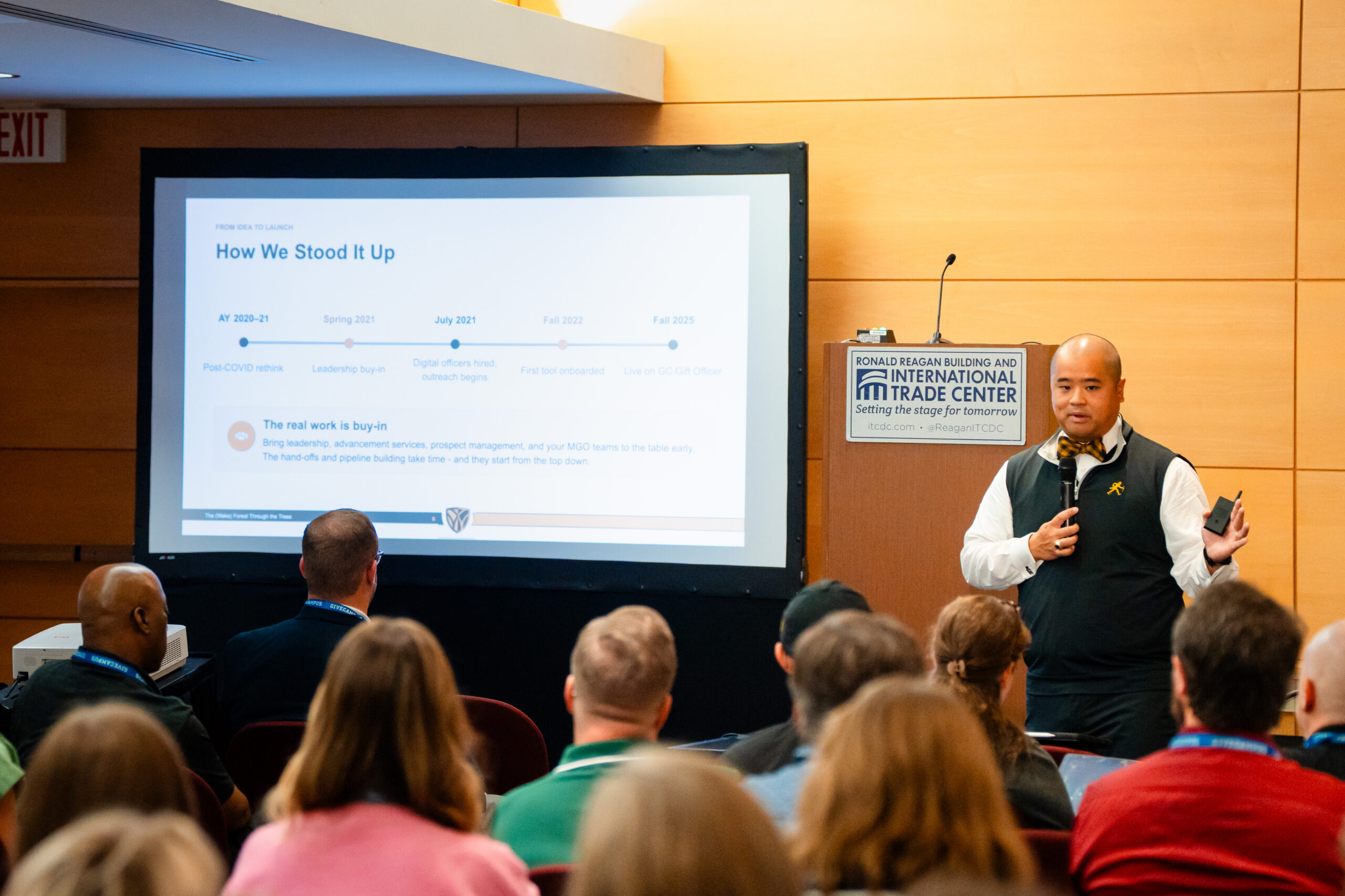
Plenty of other sessions dug into giving day strategy, volunteer management, advancement services, multi-channel outreach, and major gift fundraising, led by Partners who were generous enough to share what’s actually working (and what isn’t) at their own schools. You can find the full GCPC 2026 agenda, including every session, speaker, and topic.
Thank you for building with us
So far in 2026, the GiveCampus team has visited 641 schools in person—conversations that shape nearly everything in-person and virtual attendees saw on stage this year. GCPC is where those conversations come full circle, and this year’s record turnout made that clearer than ever.
If you missed a session or want to revisit one, this year’s new GCPC app has you covered. It’s your go-to resource for presenter information and session slide decks, including a recap of Guest Plenary Presenter Nicholas Epley’s session on the science of human connection at work. Session recordings will be added in the coming weeks, so check back often. And keep an eye on the blog for more GCPC-inspired Master Classes and best practices in the weeks ahead.